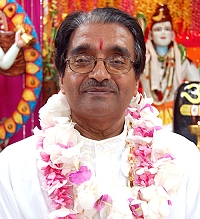

From the teachings of Paramacharya of SWAHA, H.H. Pt. Hardeo Persad
The Ramaayana is often remembered as the epic story of Shri Raam’s victory over the mighty king Raavan. Yet, beneath the historical narrative lies an eternal spiritual message: the greatest battles are not fought on distant battlefields; they are fought within our own hearts and minds.
One of the most profound moments occurs just before the war begins. Shri Raam stands before the fortified city of Lanka, preparing to confront the powerful king, Raavan. Beside Him is Vibhishan, Raavan’s own brother, who has abandoned the kingdom after refusing to support unrighteousness.
Looking across the battlefield, Vibhishan becomes troubled. Raavan commands a magnificent army, possesses extraordinary strength and rides in an impressive war chariot. Shri Raam, by comparison, appears simple and unarmed.
How could righteousness possibly triumph over such overwhelming power?
His concern reflects a question many of us ask in our own lives: How can goodness prevail in a world that often seems to reward power, pride and selfishness?
Shri Raam’s answer is one of the greatest teachings in the Raamcharitmaanas.
The Three Brothers
The three brothers of Lanka are far more than historical figures. They represent the three tendencies that exist within every human being.
Kumbhakarna symbolises Tamas, ignorance, laziness, inertia and spiritual sleep. It is the part of us that postpones growth, avoids responsibility and prefers comfort over transformation.
Raavan represents Rajas, the restless ego driven by anger, ambition, pride, attachment and the constant desire to prove itself right. When Rajas dominates, we blame others for our unhappiness and become consumed by competition, comparison and control.
Vibhishan embodies Sattva, clarity, truthfulness, humility and wisdom. Sattva allows us to look honestly within ourselves, acknowledge our shortcomings and choose the path of righteousness even when it is difficult.
Each of these brothers lives within us.
Every day we decide which one will guide our thoughts, our words and our actions.
Recognising the Internal Raavan
It is easy to identify the faults of others.
Far more difficult is recognising the Raavan that resides within ourselves.
The ego rarely appears as a ten-headed demon. Instead, it reveals itself in subtle ways: in the need to be right, the inability to forgive, the desire for recognition, the tendency to criticise others while overlooking our own imperfections.
Whenever we allow pride, resentment or selfishness to govern our decisions, that Raavan grows stronger. This is why the Ramaayana teaches that the greatest enemy is not outside us. It is within us.
Until we conquer our own ego, no external victory can bring lasting peace.
A Living Relationship with the Divine
The discourse also reminds us that spirituality is built upon relationship.
Prayer becomes meaningful when it arises from a genuine connection with the Divine. Some experience God as a loving father, others as a compassionate mother, a trusted friend, a beloved child or the eternal teacher.
When this relationship is clearly established, devotion becomes natural rather than mechanical. Our prayers are no longer mere words repeated from memory; they become heartfelt conversations rooted in love, trust and surrender.
The way we relate to God gradually shapes the way we relate to everyone else.
The Chariot of Dharma
Vibhishan’s concern about Shri Raam’s lack of a physical chariot prompts one of the most inspiring teachings in the Raamcharitmaanas.
Shri Raam explains that the true chariot of victory is not made of wood, iron or gold. It is built from virtues.
The wheels of this divine chariot are courage and steadfastness, enabling us to continue moving forward despite life’s obstacles.
The flag is Truth (Satya), reminding us that integrity must always remain visible above everything else.
Its remaining parts are fashioned from qualities such as patience, self-discipline, determination, wisdom and clarity of purpose.
These virtues become the vehicle that carries us safely through the battles of life.
Without them, even the strongest external resources cannot guarantee success.
Building the Chariot
Every day presents opportunities to construct the internal chariot.
When we choose honesty over convenience, we strengthen its flag.
When we persevere through hardship, we reinforce its wheels.
When we respond with patience instead of anger, humility instead of pride, and compassion instead of judgment, we add another essential piece to its structure.
These choices may seem small, but together they determine the direction of our lives.
The True Victory
The victory of Shri Raam over Raavan was never simply about the defeat of one king by another.
It represents the triumph of truth over falsehood, wisdom over ignorance, humility over pride and love over ego.
The Ramaayana gently reminds us that every day we stand upon our own battlefield. Each thought, each decision and each action determines whether the voices of Raavan, Kumbhakarna or Vibhishan will guide us.
Let us have the courage to recognise the internal Raavan, the humility to strengthen the qualities of Vibhishan, and the wisdom to build, piece by piece, our own Chariot of Dharma.
