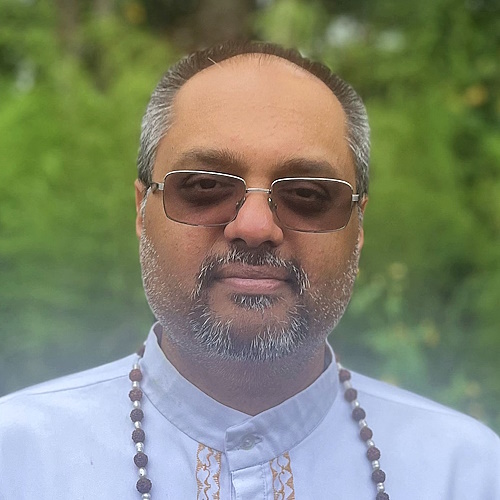



From a satsang with Pt. Dr. Umesh Persad, Spiritual Adviser, Shiva Shakti Mandir of Marion Oaks, Florida, USA
In Sanaatan Dharma, Saraswati Devi is revered as the embodiment of knowledge, learning, wisdom and creative expression. Her divine form is not merely artistic or decorative; it is deeply symbolic, carefully designed by the sages to convey eternal principles that can lead us to both academic success and a balanced life. Each element associated with Saraswati Devi points us toward qualities we are meant to cultivate within ourselves.
The Language of Symbols
Saraswati Devi is traditionally depicted with four arms. It is important to remember that these are symbols, not literal descriptions. Just as a photograph represents a loved one or a wedding ring symbolizes a marriage, the murti of Saraswati Devi represents principles and ideals. The power lies not in the object itself, but in what it signifies.
In her hands, Saraswati Devi holds three key items: a book (scriptures), a maalaa and a veena. Together, they present a complete and holistic model for human development.
The Book: Knowledge and Learning
The book or scriptures symbolise learning, education and the pursuit of knowledge. This includes formal education: what we learn from schools, teachers and textbooks, as well as scriptural study that nurtures wisdom and discernment.
In today’s world, many have replaced deep reading with short snippets of information from the internet. While technology offers quick access to knowledge, it often lacks depth and does little to stimulate imagination, reflection or critical thinking. Reading books, whether they are literature, biographies or sacred texts, can develop creativity, concentration and insight. Hindu tradition has always emphasised reading, studying and writing as essential disciplines for personal growth.
Life is not only about doing what we enjoy; it is also about doing what is beneficial. Even if reading or writing feels challenging, balance and discipline make them indispensable tools for success.
The Maalaa: Practice and Discipline
The maalaa is perhaps the most pivotal symbol. While often associated with prayer or jap, its deep message is repetition, practice and consistency.
Success, whether in academics, the arts or spiritual life, does not come from occasional effort. It comes from regular practice. Studying once is not enough; revisiting, repeating and reinforcing knowledge is what leads to mastery. This is why repetition is so powerful. Even as children, we learned the alphabet through song and repetition, which remains with us for life.
Repetition trains the mind, brings thoughts under control, and creates familiarity and confidence. The maalaa teaches that effort, patience and sustained practice are non-negotiable elements of growth.
The Veena: Creative Expression
The veena, held with both hands, represents creative expression: music, art, dance, poetry and all forms of aesthetic creativity. Saraswati Devi reminds us that creativity is not optional; it is essential.
A bird sings not to impress others, but because it carries a song within. Similarly, human beings possess an innate urge to express what is inside. Music, in particular, has a profound effect on the mind and brain. It engages multiple areas of the brain, enhances emotional balance and sharpens cognitive abilities. Many great thinkers and scientists, such as Albert Einstein and Richard Feynman, were also musicians, finding that music expanded the way they thought and understood the world.
Children especially should not be confined too early to narrow categories: “academic” or “creative”. A truly balanced individual develops both analytical thinking and creative expression. Saraswati Devi’s veena reminds us that education must have creativity to be complete.
The Swan: Discrimination and Understanding
Saraswati Devi is seated upon a swan (hamsa), an animal traditionally believed to possess the ability to separate milk from water. Symbolically, the swan represents discernment and the ability to grasp the essence of a matter.
In modern education and life, there is often an emphasis on what to learn, but little focus on why. Human beings are naturally curious: we seek meaning and purpose. Learning becomes truly effective only when we understand its relevance. Asking “Why am I learning this?” is not an act of rebellion, but an act of intelligence.
Teachers and parents alike are encouraged to begin with why, allowing children to see the purpose behind effort. When understanding is clear, commitment follows naturally.
Saraswati Devi Within Us
Taken together, these symbols offer a powerful blueprint:
- The Book teaches us to value knowledge and study.
- The Vīṇā encourages creative expression and emotional balance.
- The Mālā reminds us that practice and repetition lead to mastery.
- The Swan urges us to cultivate discernment and understand the purpose behind our actions.
Saraswati Devi is not distant or abstract. She represents principles that already exist within us. By embracing these values, we awaken our own potential for learning, creativity, discipline and wisdom. When knowledge is guided by understanding and supported by effort and expression, success naturally follows.
In this way, the symbolism of Saraswati Devi becomes not only a spiritual teaching, but a practical guide for living a meaningful and fulfilled life.
