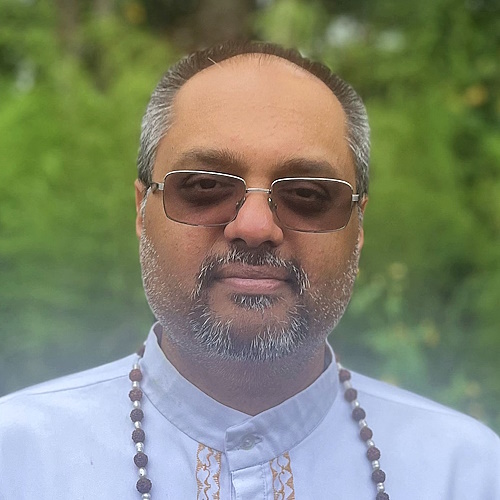

From the teachings of Pt. Dr. Umesh Persad, Spiritual Advisor, SWAHA Shiv Shakti Mandali of Marion Oaks, Fl., USA
Across the spiritual traditions of the world, seekers have attempted to define the nature of God. In Sanaatan Dharma, the scriptures offer a profound philosophical description of the Divine that goes beyond images, symbols or beliefs. One of the most concise and powerful statements appears in the Taittiriya Upanishad, which declares:
“Brahmavid aapnoti param.” The knower of Brahman attains the Highest.
This statement invites two important questions: What is Brahman? And what is meant by the Highest?
In the language of Vedanta, Brahman is the word used for the Supreme Reality; what many traditions call God. The Upanishads describe this Reality through a brief but profound definition:
“Satyam, Jñaanam, Anantam Brahma.”
This means that Brahman, the Divine Reality, is Truth, Consciousness and Infinity.
Brahman: The Infinite Reality
The word Brahman itself means the vast, the boundless or that which expands without limit. To understand this more deeply, Vedantic teachers examine the idea of limitlessness.
Everything in the world is normally limited in three ways:
- By space: it exists in one place but not another.
- By time: it comes into existence and eventually disappears.
- By object: it is one particular thing and not something else.
The Upanishadic description of Brahman removes all three limitations.
- Not limited by space: The Divine is not confined to any location. It is present everywhere.
- Not limited by time: The Divine is not born and does not perish. It always was, is, and will be.
- Not limited by object: The Divine is not one object among many; it is the underlying reality of all things.
Thus, Brahman is described as Anantam, the Infinite.
Satyam: The Ground of Existence
The Upanishads further describe Brahman as Satyam, often translated as truth. In Vedanta, however, this term carries a deeper meaning: that which truly exists and never ceases to be.
Every object in the world has two aspects:
- Name and form: the visible identity of the object.
- Existence itself: the fact that the object is.
A chair, a tree, a mountain and a human being all appear different in name and form. Yet each shares the same underlying reality: existence.
Vedantic thinkers explain this with a simple analogy. A wave appears distinctly on the surface of the ocean, but it is nothing apart from water. In the same way, the countless forms in the universe arise from and depend upon existence itself.
That fundamental existence is Brahman.
Jñaanam: Pure Consciousness
The Upanishads also declare that Brahman is Jñaanam; not merely knowledge in the ordinary sense, but pure consciousness.
Ordinary knowledge changes. We learn something, forget it and learn something else. However, beneath the changing knowledge lies something constant: awareness itself.
This awareness is present in every state of life:
- When we are awake.
- When we dream.
- Even when the mind rests in deep sleep.
Thoughts, experiences and perceptions arise within awareness, but awareness itself remains unchanged.
Vedanta therefore describes Brahman as pure consciousness, the silent witness within, from which all experiences arise.
The Highest Goal of Life
Returning to the Upanishadic statement, “The knower of Brahman attains the Highest”, we can now understand its meaning more clearly.
The Highest refers to freedom from the cycle of suffering and the attainment of lasting fulfillment. This state is not simply emotional happiness but a deep internal completeness known as aananda, or spiritual bliss.
Vedantic wisdom teaches that this fulfillment arises when a person recognises the deeper truth of their own being.
The ancient Mahaavaakya declares:
“Aham Brahmasmi”. I am Brahman.
This statement does not mean that the ego or the personality becomes God. Rather, it reveals that the true Self, the deepest consciousness within, is not separate from the infinite reality that exists in every atom of the universe.
Paths Toward Realization
Sanaatan Dharma offers several complementary disciplines to guide seekers toward this realization:
- Karma Yoga: The Path of Action
Serving others selflessly, recognising the Divine presence in all beings. - Bhakti Yoga: The Path of Devotion
Cultivating love and devotion toward forms of the Divine such as Shree Raam, Bhagavan Krishna, Shivaji or Devi. - 3. Jñaana Yoga: The Path of Knowledge
Reflecting on the teachings of the scriptures and contemplating the nature of reality. - Raja Yoga: The Path of Meditation
Training the mind through concentration and meditation.
Each path helps harmonise the hands, heart and head, guiding the seeker toward a deeper awareness of the Divine.
The Search Within
A beautiful insight expressed by the Sufi poet, Rumi, captures this truth:
“When I searched for God, I found myself.
When I searched for myself, I found God.”
In the Vedantic understanding, the journey toward God is ultimately a journey inward. The reality we seek is not distant or separate; it is the very ground of our existence and awareness.
To know that truth is to attain the highest freedom and the deepest peace.
