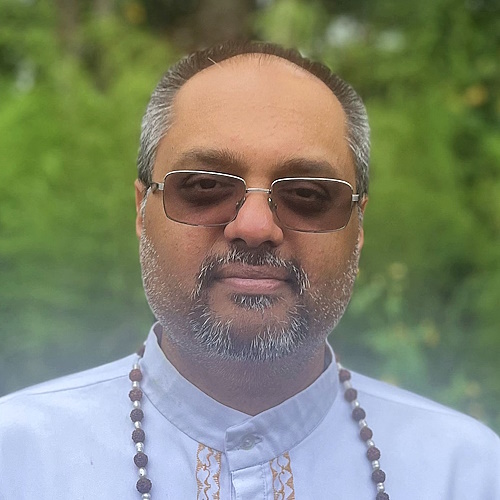

From the teachings of Pt. Dr. Umesh Persad, Spiritual Advisor, SWAHA Shiva Shakti Mandir of Marion Oaks, Florida, USA
Shree Krishna Janmashtami is more than the celebration of the birth of Shree Krishna Bhagwan. It is an invitation to look beyond the beautiful story of Shree Krishna’s appearance in the world and ask a deeper question: What does the birth of Shree Krishna mean within each of us?
Shree Krishna lived long ago, yet the story of His life continues to live in the hearts and minds of devotees. For many, He represents the Supreme Being; for others, the story offers a pathway to understanding the nature of the Self, the mind and the search for lasting happiness.
At its deepest level, Janmashtami is not simply about celebrating the birth of a divine child. It is about the possibility of the birth of something in us.
The Search for True Happiness
The Sanskrit word Krish is associated with a state of bliss. This points to a fundamental teaching: bliss is our true nature.
If bliss is already our nature, however, why do we experience unhappiness and suffering?
The answer lies in the mind.
Our scriptures describe man, the mind, and teach that the mind can become the cause of either bondage or liberation. What we think, how we think and what we continually pursue shape our experience of life.
We often look outside ourselves for happiness. We pursue relationships, possessions, success, status, comfort and security, believing that these things will make us complete. Yet everything we acquire also brings responsibility, maintenance and worry. What gives us pleasure can eventually become a burden.
This does not mean that relationships, possessions or worldly experiences are not to be pursued. Rather, the spiritual teaching asks us to recognise their limitations. They may bring happiness for a time, but they cannot provide permanent fulfilment.
Eventually, the sincere seeker begins to ask: Is there something beyond all of this that can give lasting happiness?
That question marks the beginning of a deep spiritual journey.
Bhajan: To Seek and Find
The word bhajan is often associated with singing devotional songs, but its deeper meaning is to seek.
There is an important distinction between searching and seeking. When we search for something, we generally know what we are looking for.
Seeking is different. We may sense that something is missing without fully knowing what we are seeking.
In the spiritual journey, we seek the truth of who we are.
Some may worship God through devotion, prayer and the glorification of Shree Krishna. Others may be drawn towards philosophical inquiry. Both methods have value. What matters is that the journey ultimately turns inward.
The purpose of devotional practice is not merely to sing beautiful songs or perform rituals. Bhajan should become a means of going deeper inside the self and discovering the happiness that is already there.
The Story of Shree Krishna’s Birth
The traditional story of Shree Krishna’s birth begins with the oppression caused by the powerful King Kamsa. His actions had become a burden upon the earth, and people suffered under his rule.
The story presents the king not simply as an evil person somewhere in the distant past, but as a representation of tendencies that can exist within all of us.
Power, wealth and influence can distort the mind when they are not accompanied by compassion and self-awareness. When a person becomes consumed by the desire to control others, that desire can eventually control the person. The scriptures therefore invite us to look within ourselves.
What makes a person good or bad? Much of it begins with the mind: what we think, what we desire and what we choose to do.
The story reminds us that the struggle between positive and negative tendencies is not merely an external struggle. It is an internal one.
Kamsa, Devaki and Vasudeva: An Internal Story
King Kamsa’s sister, Devaki, married the noble Vasudeva. After hearing a prophecy that Devaki’s eighth child would be responsible for his downfall, Kamsa became consumed by fear.
Devaki and Vasudeva were imprisoned, and the king destroyed their first six children. Their seventh child, Balarama, was transferred to the womb of Rohini and was preserved.
Then came the eighth child. Shree Krishna was to be born.
The story is dramatic, but its deeper meaning is revealed when the characters are understood symbolically.
The king represents the ego; the strong identification with the individual self, the constant desire to acquire, control and manipulate the world in the belief that doing so will bring happiness.
Devaki represents the good qualities within us: compassion, kindness, truthfulness, non-aggression and other noble tendencies.
Vasudeva represents awareness.
The spiritual practice, therefore, is to bring our awareness towards the good qualities within us rather than allowing the ego and its desires to dominate our lives.
When awareness is joined with goodness, something begins to develop in us.
The Six Children and the Birth of Spiritual Qualities
Devaki and Vasudeva’s first six children are given a deeper interpretation in the discourse.
They represent six qualities that can develop through spiritual practice: control of the mind, control of the senses, withdrawal, endurance, mental firmness and faith.
These qualities are not automatically established simply because we attend religious ceremonies or practise devotion. They have to be cultivated.
And yet the ego can repeatedly destroy them. We may resolve to control our minds, restrain our senses or practise patience, only to find ourselves returning to old patterns. The story therefore reflects the repeated struggle within us between our higher aspirations and our habitual tendencies.
Spiritual growth requires persistence. We continue trying. We continue becoming aware. We continue practising.
Balarama: The Birth of Mental Strength
The seventh child is Balarama.
Bala means strength, while Rama is associated with that which shines within. Balarama therefore represents mental strength.
After repeated spiritual practice, something begins to change. We develop the strength to resist the tendencies that previously controlled us.
This inner strength is essential.
It gives us the ability to pause before acting, to recognise our impulses and to choose differently. Instead of automatically following every desire or thought, we begin to exercise conscious choice. With the development of this inner strength, the way is prepared for the birth of Shree Krishna.
The Birth of Shree Krishna
Finally, the eighth child is born: Shree Krishna.
But there is an important detail in the story. Shree Krishna does not remain where He is born. He is carried across the Yamuna River and hidden in the home of Nanda Baba and Yashoda.
The Yamuna is interpreted as a twin, pointing towards the idea of two selves operating within us. There is the self we ordinarily experience: the individual person sitting here, thinking, acting and identifying with the body and mind. But behind this apparent self is the true Self, the witnessing consciousness, the Supreme Self, Brahman.
The ordinary sense of “I” appears and disappears. We experience it when we are awake, but in deep sleep our ordinary sense of individuality is absent. The true Self, however, is deeper than this changing personality. In this interpretation, Shree Krishna is the true Self hidden within us.
The story of Shree Krishna crossing the Yamuna River therefore becomes an image of an inner spiritual process: the discovery that beyond the body, beyond the mind and beyond the changing sense of individuality lies the witnessing Self.
From Story to Self-Realisation
The beautiful scriptural stories are not merely stories to be enjoyed. They point towards something deeper. The characters, events and symbols can be understood as reflections of our own inner lives.
Kamsa is within us when the ego takes control.
Devaki represents the goodness within us.
Vasudeva represents awareness.
Balarama represents the inner strength required to pursue the spiritual path.
And Shree Krishna represents the Supreme Self, the blissful consciousness that is our true nature.
The final destruction of the evil king represents liberation: the overcoming of the ego and the realisation of who we truly are. This is the deeper journey from the external world towards Self-realisation.
What Does Janmashtami Mean to Us?
It is easy to celebrate Shree Krishna Janmashtami as the birthday of a divine child. There is joy in the story, beauty in the devotional songs and warmth in the rituals surrounding the celebration. But Janmashtami invites us to go further.
We can ask ourselves: What is being born within me?
Has my spiritual practice made me more compassionate?
Am I becoming more aware of my thoughts and actions?
Am I developing greater control over my mind and senses?
Do I have the inner strength to resist negative tendencies?
Am I becoming less controlled by my ego and desires?
And, most importantly, am I moving towards the recognition of the Self that lies beyond the changing personality?
