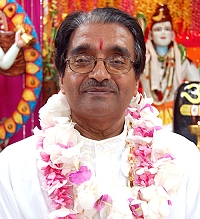

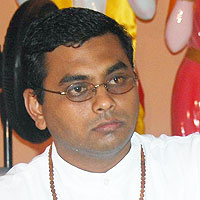
A “SWAHA Viewpoint” interview with the Paramacharya of SWAHA, H.H. Pt. Hardeo Persad, with Pt. Adesh Maraj
Pt. Adesh Maraj: Guruji, I want to take this opportunity to ask you to clarify some misconceptions surrounding Pitra Paksha, particularly those related to the Pitras (departed souls).
We are told that during Pitra Paksha, the gates of Pitrlok open and the Pitras come out to receive the food that is offered to them. According to the story, some of these Pitras are unfortunate because they have no family members to offer them food. As a result, they return hungry when the gates close and have to wait until the following year.
Where did this story originate, and is there an inner meaning to it? And, by extension, what exactly is a Pitra?
Guruji: This whole idea of Pitrlok as a gated community is something I use in my own mind to conceptualise how people think about it. The gates are locked, and at a particular time all the souls come out.
A Pitra is a departed soul, but it is also a status that we, from our perspective, give to that departed soul. I mentioned in the last programme that the soul could already have been reborn. I do not want to pontificate about where the soul goes after five days, ten days or any other period because nobody can see the soul. Yet we hear all kinds of stories. There is very little substance to some of those ideas. We have to return to what Bhagwan Krishna tells us in the Bhagavad Gita.
In Chapter 2, Verse 24, the soul is described as eternal and all-pervasive. The only thing that is truly all-pervasive is Brahman. This is why we say that we are all Brahman, but because of Maayaa, we perceive individuality.
The soul is immovable. If the soul is infinite, is there any room for movement? If you have a container that is completely filled to capacity, is there any room for anything to move inside it?
It is also immutable, unchangeable and everlasting. The Gita tells us that it is neither born nor destroyed.
Therefore, whenever we hear these stories, we have to interpret them in relation to what Bhagwan Krishna teaches us in the Gita.
Chapter 2, Verse 23 tells us that fire cannot burn the soul, wind cannot dry it, weapons cannot cut it, and water cannot affect it. Food is of the nature of Prithvi tattwa (earth). If the tattwas have absolutely no effect on the soul, then how does the soul eat?
The whole concept of the soul coming to eat, becoming hungry and then returning is therefore inconsistent with what the Gita teaches. The soul is neither hungry nor thirsty.
People sometimes say that a deceased father appeared in a dream and said that he was hungry or thirsty. Dreams can be very powerful, and the mind can create experiences that feel completely real. I am not saying that such dreams cannot have meaning or that they cannot encourage someone to do something positive. But we should not automatically assume that the deceased soul has literally returned because of the dream.
If the soul has already been reborn, how could that same soul come back simply because someone has dreamed about the person?
So let us return to the main point: the Panch Rin, the five debts that we owe.
Pitra Paksha and the Debt of Gratitude
Pitra Paksha is a special period set aside for us to reflect upon the contributions of our ancestors.
We have Mother’s Day, Father’s Day, Brother’s Day and other occasions on which we acknowledge people and their contributions. Hinduism has set aside these two weeks for us to reflect specifically upon the contribution of our ancestors.
There is a teaching that says, in essence, that one who takes without giving is a thief. Pitra Paksha gives us an opportunity to examine where we have come from, where we are now, and where we intend to go in the future.
The purpose of Pitra Paksha is not simply ritual. It is an opportunity to reassess our lives and plan our future. There are rituals associated with Pitra Paksha, including offerings, but these are connected to the larger principle of repaying the five debts.
That is essentially what Pitra Paksha is about: helping us repay the debts of gratitude. We have to repay these debts in whatever appropriate form we can. Hinduism has created these practices to help free us from bondage, not to bind us.
The Significance of the Fire in Pitra Rituals
Many people ask why certain forms of puja are not performed during this period.
In the rituals, we use consecrated fire. When we perform ordinary puja, the fire is consecrated as Brahmagni. During Pitra rituals, however, the fire is consecrated as Dakshinagni. The Pitra fire is associated with the southern direction, the direction of Yama Raja. Therefore, the fire used has a different consecration and function.
The same fire can have different ritual functions depending on how it is consecrated and for what purpose it is being used.
When performing Pitra rituals, the appropriate form of consecrated fire is used, and offerings are made to the Pitras as part of the repayment of the debt to them.
The same principle of the five debts applies. For example, in a simple form of practice, one may perform havan, offer food and perform the appropriate acts of worship and remembrance.
The important thing is to understand what we are doing rather than simply performing an external action.
There Are No Shortcuts to Gratitude
People sometimes ask how many days they should make offerings. Some may offer water for three days, others for five days, while others may observe the practices for the full period.
I sometimes ask: Why only three days? Why not fifteen? People often want to take shortcuts. But there is no shortcut when the purpose is to repay a debt of gratitude.
We may perform the required rituals within a shorter period where tradition or circumstance permits, but that does not mean that the underlying responsibility disappears.
When someone dies, the physical body is cremated. We have to understand what happens to the body and distinguish that from the nature of the soul.
People can exploit the ignorance of others during this period. Someone may dream that their deceased father is thirsty, and this may frighten them into believing that they have failed to make an offering. But perhaps the dream is simply a reminder from one’s own mind that there is a debt of gratitude that needs to be acknowledged.
If the soul has already been reborn, the idea that the same soul has physically returned to ask for food or drink does not make sense.
Therefore, there is a great deal of unnecessary fear surrounding Pitra Paksha. But if properly understood, it is a very important period, a time during which spiritual merit can accrue because we are consciously repaying our debts of gratitude.
Who Should Perform the Pitra Rituals?
Interviewer: Guruji, for the benefit of the public, I would like to clarify some misconceptions about the actual rituals. Some people offer water for five days, some for fifteen days, and some do not perform the rituals at all. There is also a traditional belief that one male member of the household should observe this period.
Guruji: As far as I am concerned, repaying the debts of gratitude is the responsibility and obligation of every person.
Sometimes we see one person in a household performing the rituals. This may be because of a traditional practice in which one male member of the family assumes responsibility. But the responsibility belongs to everyone.
If the last son in the household performs the Pitra ritual, he is performing it for himself. My brothers perform it for themselves. Each person performs it for himself because each person has a responsibility to repay these debts of gratitude.
If we think that the purpose is simply to give food to a deceased person so that the person becomes satisfied, then we have misunderstood the entire concept. That is why I am asking for a paradigm shift in our understanding.
The ritual is not being performed to feed the person who died. You cannot feed the soul. Food is for the body, not the soul. The soul is unaffected by food.
Can Women Perform Pitra Rituals?
Interviewer: So, to make this explicit: mothers, sisters and daughters can also perform these rituals?
Guruji: Yes. Many women do so.
There are, of course, questions relating to lineage and marriage. When a woman marries, she becomes part of another lineage, and traditional practices may differ accordingly.
But again, we must return to the underlying principle. What is the best way to honour your parents? It is not simply by performing a ritual.
The best way to honour your parents is by living the right life, maintaining the principles they taught you and fulfilling your duties. Rituals have their place, but principles are more important than ritual alone.
Some people may derive psychological comfort from performing rituals. But if you maintain the principles and live according to your duties, you accrue greater merit than by simply performing a ritual. You may perform the ritual if you wish, but do not confuse the ritual with the principle behind it.
Adapting Rituals to Time, Place and Circumstance
Interviewer: As we are discussing rituals, one question naturally arises. You have mentioned several times the importance of time, place and circumstance. What happens in places abroad, where it may be difficult to light an open fire or obtain particular grasses, leaves and other traditional ingredients? What rituals can people perform in those circumstances?
Guruji: That is a good question, and the answer is simple.
Even in India, do you think everyone has access to all the traditional ingredients everywhere?
We have to understand the inner meaning of everything we do. Once you understand the inner meaning, you can adapt the practice according to your circumstances.
You can read a Gita wherever you are. You can offer water. If you have the appropriate kusha grass, you can use it. If you do not have it, you have to work within your circumstances. There have always been adjustments and adaptations.
If you are in a cold climate and cannot perform rituals outside, you can place a flowerpot indoors and make your offering there. You can adapt the external practice. But even if you cannot perform the physical ritual, what matters is how you live.
Read the Bhagavad Gita. Worship the Divine. Maintain the right principles. Maintain the practices and value systems of your ancestors. That is Pitra Paksha. You can also give charity in the name of the departed.
Therefore, wherever you are, Hinduism can survive. It can be practised under any circumstances. Even havan can be adapted. There are places where you are not permitted to light a large fire. There is a much smaller form of the practice, using a little wick. The mindset that the fire has to be physically large is not the point. The presence and significance of the fire is what matters. So, yes, you adapt according to the circumstances.
The Inner Meaning of Havan
There is also a more inward form of havan. A person who has renounced worldly possessions, for example, can perform havan symbolically. The fire represents the fire of desirelessness, and one’s karmas become the ingredients offered into that fire.
Most of us still want to perform things physically, but there are different levels of practice. When we speak about puja, there are three ways of performing it: mansik, vaachik and upanshu.
Mansik is worship performed in the mind. Vaachik involves mantras and spoken prayer. Upanshu involves physical offerings. This is another reason Hinduism can survive anywhere, even where the physical environment makes traditional rituals difficult.
If I cannot perform the physical ritual, I can chant the mantras. If even that is difficult, I can perform the worship mentally. This is why I keep saying that Hinduism is not limited to external circumstances.
When you perform the practice mentally, you are still engaged in worship. When you perform the ritual physically, however, the actions also have an effect on the surrounding environment.
Bhagwan says that a flower, fruit or other offering may be offered; what matters is the attitude with which the offering is made.
Whatever we offer within our limitations, it is the purity of the mind and the attitude of the devotee that matter.
The Deeper Meaning of Gowdaan
Interviewer: Coming back to the rituals associated with Pitra Paksha, I would like to ask about Gowdaan. There is a particular story that says a person should give a cow before death so that the person can cross the river Vaitarani, which is described as a river in hell. Is this literally true? And, considering what you have said about adapting the philosophy to our circumstances, what is the relevance of Gowdaan?
Guruji: There are several questions we can ask about this.
First, how do you know if you are going to hell? Then there is another practical question. If I give a cow before I die, how much time does it have to be delivered? What happens if I am in a different part of the world? If you take everything literally, the story becomes difficult to reconcile with reality.
Chanakya Maharaj put it in a particular way. The river is symbolic of a river of lust. Think about how devastating lust can be and how it can contaminate a person’s life. So what does it mean to give a cow in order to cross the river of lust?
The word go refers to the senses. What causes lust? Distraction and attraction through the senses. Therefore, Gowdaan can symbolise offering up or gaining control over the senses. The holy person, through prayer and spirituality, helps us bring the senses under control so that we can cross that river. It is not simply about giving a physical cow.
The Knowledge of the Gita
If you study the Gita, you will find that knowledge has tremendous value. I often make the point that people sometimes carry religious books on their heads as part of a ritual. I would rather see the book inside the head. The purpose of the Gita is to put its teachings in the mind and one’s life.
Gowdaan, if understood properly, can be just as meaningful, or even more powerful, when its inner meaning is understood. The cow becomes a symbol of the senses, and Gowdaan becomes an offering of those senses through discipline and spiritual practice.
The deeper meaning is therefore more important than just performing the external ritual.
(The full interview and other SWAHA Viewpoint videos with the Paramacharya can be accessed on ieTVtt’s YouTube channel.)

Leave a Reply