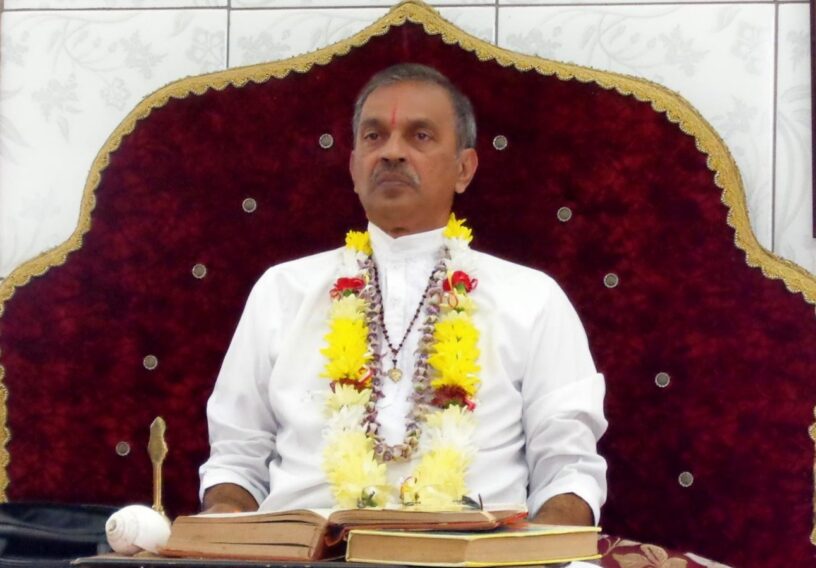

From the teachings of Pt. Gyandeo Persad, Spiritual Leader, SWAHA Sukh Shanti Bhakti Mandali
With humility and devotion, devotees must seek the blessings and eternal mercy of Shree Krishna, the Supreme Lord and eternal guide of all beings. In the Bhagavad Gita (Chapter 10, Verse 12), Arjuna, in his reverent invocation, proclaims:
“O Lord, You are the Supreme Divinity, the Supreme Divine Personality, the Supreme Purifier, the Eternal God, the Primal Being, the Unborn. The great sages such as Narad, Asit, Devala and Vyaasa have all declared this truth. O Lord, we bow to You in prayer.”
Through the sacred dialogue of the Bhagavad Gita, Shree Krishna reveals eternal wisdom to guide humanity toward truth and liberation. Among His many teachings, He emphasizes the path of unwavering devotion. In Chapter 9, Verse 14, He declares:
“Constantly chanting My names and glories, striving for My realization, bowing again and again to Me, those devotees, firm in resolve and ever united with Me through meditation, worship Me with single-minded devotion.”
This divine instruction calls upon us to keep our hearts and minds anchored in remembrance of Him, through prayer, praise and continuous devotion.
Addressing the nature of worship and faith, Shree Krishna further explains in Chapter 9, Verses 23–25:
“Those devotees who, endowed with faith, worship other deities, in truth worship Me alone, though in a mistaken manner. For I am the enjoyer and Lord of all sacrifices, yet they do not recognize Me as the Supreme Reality. Those who worship the Gods go to the Gods; those who worship ancestors go to them; those who worship spirits go to them. But those who worship Me come to Me alone.”
In these profound words, Shree Krishna affirms that all paths of worship ultimately lead to Him, though true understanding lies in recognizing Him as the Supreme Purusha, the highest Divine Reality. Devotees who worship with such knowledge and surrender transcend the cycle of birth and rebirth, attaining liberation. Others, guided by their desires and actions, continue within the cycle of samsara, experiencing the fruits of their karma.
From His childhood pastimes, such as the lifting of Mount Govardhan and the acceptance of offerings from His devotees, Shree Krishna has continually guided humanity toward sincere devotion to the Divine. His message remains clear: to transcend worldly existence and attain liberation, one must turn wholeheartedly toward Him.
Yet, how are we to worship Him? Shree Krishna teaches that there are many paths, but among the simplest and most accessible is the path of bhakti: devotion expressed through kirtan and bhajan, the singing of His divine names and glories. In our human imperfection, we may falter, but sincere devotion purifies and uplifts the soul.
Arjuna himself, in a moment of deep humility (Chapter 11, Verses 41–42), seeks forgiveness from the Lord:
“O Lord, thinking of You as a friend, I have often addressed You casually, unaware of Your greatness. In moments of familiarity, while resting, eating or in the company of others, I have failed to honour You as the Supreme. For all such offences, I seek Your forgiveness.”
This heartfelt prayer reminds us of our own limitations and the need for humility before the Divine.
Recognizing Shree Krishna as the Supreme Lord of the universe, we are called to dedicate our lives to Him: to sing His praises, listen to His glories and walk the path of devotion with sincerity. In times of joy and in moments of adversity, it is to Him that we turn.
As long as there is life and breath within us, let us remain steadfast in prayer, ever seeking His presence. For it is through devotion, surrender and remembrance that we advance towards Him, and ultimately, by His grace, attain the supreme goal of liberation.
