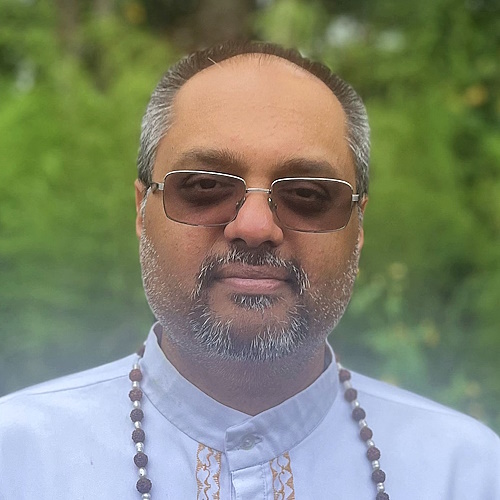

From a satsang with Pt. Dr. Umesh Persad, Spiritual Advisor, Shiva Shakti Mandir of Marion Oaks, Fl., USA
To truly benefit from religious observances, whether the performance of havan, the chanting of mantras or acts of prayer, it is essential to understand their purpose. Spiritual rituals are deliberate actions that influence the body, the mind and consciousness itself.
Offerings are not made to a distant or external deity. Rather, they are symbolic acknowledgements of the One Supreme Principle, known variously as God, the Universe, Consciousness or Atman. Across all spiritual traditions, the ultimate aim is the same: union with this supreme reality through contemplation, prayer and meditation. These practices are not performed for divine approval, but for the transformation of the individual seeker.
One Consciousness, Many Forms
Sanaatan Dharma teaches a profound and uncompromising truth: there is only one Consciousness. This Supreme Spirit manifests as the numerous forms and experiences that constitute the universe. Every being, every object and every force is an expression of this single reality.
Yet the question remains: do we truly experience this oneness in our daily lives?
The Ocean and the Wave
To understand this truth, the sages offer an eternal comparison of the ocean and its waves. The ocean represents the infinite, formless totality, Consciousness itself. Waves arise from the ocean, animated by its power, existing briefly before dissolving back into it.
Each of us is like a wave, appearing for a time, shaped by circumstances, then returning to the source. The sense of individuality, so firmly held during waking life, is ultimately an illusion. This becomes evident in deep sleep, where the ego is absent and the sense of separateness disappears.
Everyday perceptions, thoughts and identities are fleeting, passing like clouds across the sky. Recognising this impermanence is a vital step toward spiritual awakening.
Many Paths, One Truth
Sanaatan Dharma compassionately acknowledges the diversity of human temperaments and therefore offers multiple spiritual paths. Divine manifestations such as Shree Raam, Krishna Bhagavan and Bhagavan Shiva are not separate gods, but personal expressions of the one Supreme Reality. They are forms through which the limited mind can relate to the formless.
While the forms may differ, the destination remains the same: the realisation of unity and oneness.
The Power of Sound and Vibration
When we pray or chant, the vibrations we generate are not confined by physical space. Sound operates on a subtle level, resonating beyond visible boundaries. This is why sound plays such a central role in spiritual practice, through bells, conches, gongs and especially mantras.
The word mantra itself reveals its purpose:
- Man — mind
- Tra — technique
A mantra, therefore, is a technique for the mind, a precise tool that refines awareness and reshapes consciousness.
The Meaning of “Om Namah Shivaya”
The mantra “Om Namah Shivaya” honours Bhagavan Shiva, who symbolises both stillness and movement, the unchanging Absolute and the dynamic universe. Just as the ocean remains still while waves rise and fall upon its surface, Shivaji represents the eternal presence within constant change.
The syllable “Om” is the primordial sound, the fundamental vibration from which all creation emerges and into which it ultimately dissolves.
“Om Namah Shivaya” is known as the Panchaakshar Mantra, the five-syllable mantra. It acts as a pump for consciousness, awakening and energising the subtle centres within the body known as chakras. These chakras are not physical organs, but fields of awareness, each representing a particular state of consciousness.
Through repeated chanting, energy is gently elevated from lower to higher states, guiding the seeker toward clarity, stillness and internal expansion. This is not a mechanical or intellectual process; it is deeply experiential.
Chanting as Internal Alignment
As we chant “Om Namah Shivaya,” we are invited to attune ourselves to the vibration that permeates both the universe and our own inner being. The mantra is not something external to be recited; it is a resonance to be recognised within.
Through sincere and mindful practice, chanting becomes a bridge, from individuality to unity, from noise to silence, from fragmentation to wholeness.
In this awareness, we move closer to the realisation of our true nature: not waves, but the infinite ocean itself.
