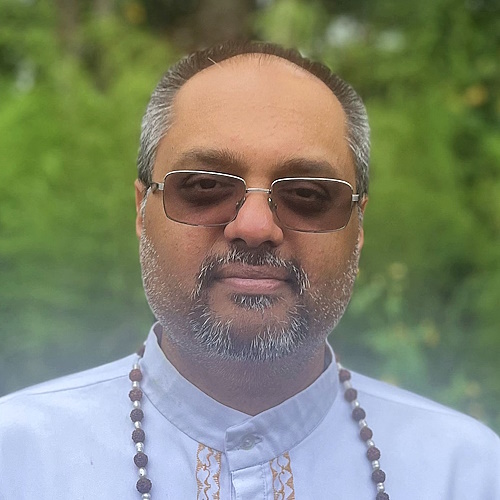

From the teachings of Pt. Dr. Umesh Persad, Spiritual Advisor, Shiva Shakti Mandir of Marion Oaks, Florida, USA
Among the greatest spiritual teachers in the history of Hinduism, few have had as profound an influence as Adi Shankaracharya. Revered as a philosopher, reformer and saint, he revitalized the spiritual traditions of India and brought together the many devotional streams of Hindu thought: those devoted to Shiva, Vishnu and Devi, under the unifying philosophy of Advaita Vedanta.
At the heart of his teaching lies a bold and transformative truth: beneath the changing world and the restless mind, our real nature is none other than the Infinite itself.
The Great Declaration of Vedanta
The philosophical foundation of Vedanta is expressed in the famous mahaavaakya:
Tat Tvam Asi — “That Thou Art.”
This teaching declares that the essence of the individual soul is identical with Brahman, the limitless and eternal Reality underlying all existence.
In the classical formulation: Brahma Satyam, Jagan Mithyaa, Jeevo Brahmaiva Naaparah.
This means:
- Brahman alone is the ultimate Reality.
- The world, though experienced, is transient and appearance-like.
- The individual self is none other than Brahman.
This teaching may seem startling. How can the ordinary person, burdened by limitations and struggles, be identical with the Supreme? Yet this is the central revelation of the Vedic sages.
The spiritual journey is therefore a process of discovering, not becoming, what we have always been.
The Two Fundamental Human Problems
According to Vedanta, every human being is driven by two deep concerns:
- The Problem of Suffering
No matter what we acquire, life inevitably brings disappointment, loss and change.
- The Search for Lasting Happiness
From childhood onward, we seek fulfilment through toys, achievements, relationships, wealth and recognition. Yet every gain provides only temporary satisfaction.
What we truly long for is not fleeting pleasure, but enduring peace and completeness.
The Donkey and the Carrot
A vivid analogy illustrates this condition.
A stubborn donkey is enticed forward by a carrot suspended just beyond its reach. The animal continues walking, convinced that the next step will bring satisfaction, yet the carrot always remains ahead.
Human life often unfolds in the same way.
We pursue one goal after another: a new possession, a relationship, a career achievement, believing that each will finally make us whole. But lasting fulfilment remains elusive because all external objects are impermanent.
The problem is not that worldly pursuits are wrong. Rather, they cannot provide what only the eternal Self can offer.
The Four Goals of Human Life
Sanaatan Dharma identifies four legitimate aims of life:
- Dharma: righteous living and moral order
- Artha: material prosperity and security
- Kaama: enjoyment and emotional fulfilment
- Moksha: spiritual liberation
The first three are necessary and meaningful, but they do not satisfy the deepest yearning of the heart. Only the realization of one’s true nature, brings permanent freedom and peace.
The Feeling of Incompleteness
Why do we continue searching outside ourselves?
Vedanta explains that the human mind is haunted by a subtle sense of insufficiency: a feeling that “something is missing”. Believing ourselves to be incomplete, we seek fulfilment in external objects and experiences.
Yet the Isha Upanishad and other scriptures proclaim the truth of Purnam: wholeness.
Our essential nature is already complete. Nothing needs to be added to the Self.
The Dream Analogy
To understand the relationship between the world and Brahman, the sages offer the analogy of a dream.
In a dream, the dreamer, the dream world, and every character exist within a single consciousness. When one awakens, it becomes clear that all of it arose in and was sustained by the dreaming mind.
Likewise, the universe and all beings appear within the infinite consciousness of Brahman.
We are not separate from that Reality; we are expressions of it.
The Only Knowledge That Saves
Secular knowledge is valuable. Education, science, medicine and scholarship enrich human life and serve society. But at the time of death, no accumulation of information can provide ultimate security. Only Self-knowledge, the recognition of one’s identity with Brahman, offers permanent freedom and comfort. This is why spiritual wisdom occupies the highest place in life.
Peace Amid Life’s Storms
The repeated invocation “Om Shanti, Shanti, Shanti” is a prayer for peace amidst three categories of suffering:
- Physical and mental difficulties
- Problems arising from other people and society
- Natural and environmental forces beyond our control
The goal is not to eliminate every challenge, but to discover an inner stillness: the calm eye at the midst of life’s activity.
Washing Away the Mud of Worldliness
Spiritual life is a gradual process of cleansing.
We inevitably return to the world and become entangled in its worries and attachments. Yet each visit to the temple, each act of reflection and each moment of sincere inquiry helps wash away a little more of the “mud”.
Over time, the mind becomes clear, light and more peaceful. Eventually, one recognizes that the completeness long sought outside was present within all along.
The Eternal Message
Adi Shankaracharya’s message remains as relevant today as it was over a thousand years ago.
We may pursue careers, nurture families and fulfill our worldly responsibilities. These are important parts of life. But if we neglect the central question, “Who am I?”, we risk missing the deepest purpose of human existence.
The sage therefore offers us a compassionate call to awaken:
Seek the Divine. Know your true Self. Discover the peace that neither time nor circumstance can destroy. In the final analysis, all other knowledge fades, but the knowledge of the Self alone liberates.
