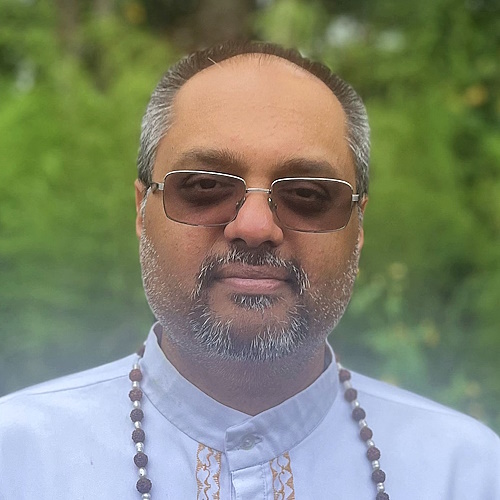

From a satsang with Pt. Dr. Umesh Persad, Spiritual Leader, SWAHA Shiva Shakti Mandir of Marion Oaks, Florida, USA
This month, we observe the festival of Ashaadha Gupta Navraatri, which began in the month of June and culminates on July 4. Though it is not as widely celebrated as the Sharad or Chaitra Navraatri, the Gupta—or “secret”—Navraatri offers a deeply introspective opportunity to honour the Divine Mother in Her subtlest forms.
During this auspicious time, we worship that Supreme Energy—the dynamic, creative force of the universe—manifested as Devi, the Mother of all. She is the pulse of life, the reason all things move, grow, transform and evolve. In Sanaatan Dharma, the energies that shape creation are not abstract; they are personified as Devi, the supreme feminine consciousness.
One of the unique strengths of Sanaatan Dharma is its openness: the Supreme may be envisioned in any form the devotee chooses. Among these, the image of the Divine Mother holds a special place. Just as our earthly mother tends to us, answers our cries, nourishes our every need and nurtures our spirit, so too does the Divine Mother embrace Her devotee with unconditional compassion. When we relate to the Divine as Mother, She in turn responds to us as a mother does—tenderly, caringly and eternally.
Though we celebrate many festivals throughout the year, it is vital to remember that they all lead to the One Supreme Spirit, perceived through different perspectives. During Navraatri, this One is honoured in many powerful forms: Durga, Lakshmi, Saraswati, Kaali, the Nav Durgas and the Chausath Yoginis. These are not different Goddesses, but manifestations of the one Devi, each embodying a different facet of Divine Energy.
These forms govern everything—sleep, hunger, thirst, desire, emotion, and so forth. Even our thoughts and motivations are expressions of Devi. She is the one who stirs all life into motion. Everything is Her—the visible and invisible, the gross and the subtle.
The Devi Bhagavatam beautifully outlines the three levels of worship, offering seekers a ladder from outer ritual to internal realisation:
- Rituals and offerings: the entry point of worship, akin to preschool in spiritual development. These are practices that cultivate purity (bhoot shuddhi) and devotion.
- Mantra and stotra recitation: the secondary level, where sound vibrations uplift the consciousness and deepen connection.
- Meditation and contemplation: the highest form of worship. Here, one transcends the mind, enters stillness and becomes established in the Self. This is spiritual university—where the seeker realises that the Divine is not outside but within.
Rituals are vital, but they are meant to be a beginning, not an end in themselves. Just as we do not remain in preschool forever, we are not meant to stay confined to outer forms alone. Even if one is in a setting where formal offerings like dhaar are not possible, prayer and sacrifice remain profoundly powerful.
The journey of the soul involves movement from pravritti marg (the path of engagement with the world) toward nivritti marg (the path of renunciation and self-discovery). We must ask ourselves, Where am I on the path?
The great irony is that what we seek—God, divinity—is already within us. It is always present, yet obscured by the noise of the mind. One of the most sacred practices on the spiritual path is silence. True silence is not the absence of sound, but the stillness of mental agitation. By observing the mind without attachment, we gradually quiet its fluctuations.
This is the heart of Yoga: “Yoga cittavritti nirodhah” — Yoga is the stilling of the modifications of the mind.
As we reach the culmination of Ashaadha Gupta Navraatri, let us light the lamp of awareness. Let us honour the Devi in Her numerous forms—not only in sacred chants and rituals, but in every heartbeat, breath and in the still depths of the soul. For it is there that the true Mother resides—eternal, compassionate and with us always.
