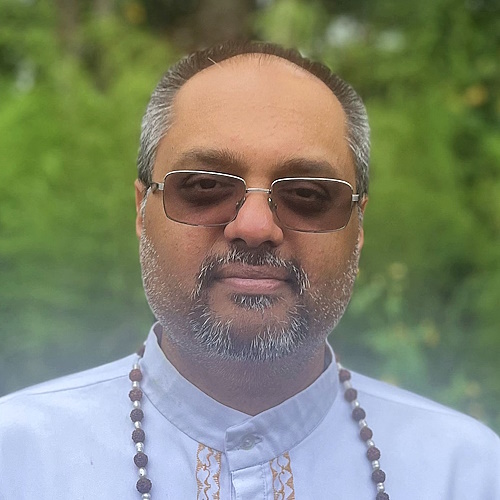
From the teachings of Pt. Dr. Umesh Persad, Spiritual Leader, Shiv Shakti Mandir of Marion Oaks, FL., USA
On the auspicious occasion of Nav Raatri, devotees gather in worship of Devi Maa, the Supreme Goddess and the Divine Energy that sets all creation into motion.
Nav Raatri is a sacred period during which our attention turns towards Shakti, the dynamic energy of the Supreme. At the heart of this worship lies a profound understanding: there is ultimately one Supreme Spirit, understood through different forms and perspectives.
The very name of the temple, Shiv Shakti, expresses this unity.
Shiva and Shakti: Stillness and Movement
Shiva and Shakti are not two different Gods. They represent two complementary aspects of the same Supreme Reality.
The word Shiva may be understood through its two components, Shi and Va. Shi represents that which is static, motionless and unmoving. Beneath the constant movement and changing forms of creation is a singular, all-pervading consciousness: the awareness that exists everywhere and serves as the foundation or substratum of existence.
As we learn through the teaching Tat Tvam Asi, “That Thou Art,” that Consciousness is not separate from us. That which is the foundation of existence is within each of us.
The Va component represents movement.
Thus, we can contemplate Shiva and Shakti as stillness and movement: the unchanging consciousness and the dynamic energy through which that consciousness manifests as the countless forms of creation.
Everything we experience is associated with energy. The universe is in constant movement, and that movement takes innumerable forms.
Devi: The Supreme Energy
In Sanaatan Dharma, the Supreme may be conceived in several ways. We have the freedom to conceive of the Divine as Father or as Mother, according to the relationship through which we best understand the Supreme.
During Nav Raatri, we worship the Supreme as Mother.
This is more than a form of religious imagery. It establishes an intimate relationship between the devotee and the Divine.
What does a mother do for her child? She cares for the child, responds to the child’s needs and attends when the child cries. By worshipping the Supreme as Mother, we place ourselves in the place of the child and understand the Divine through this relationship of love, care and shelter.
Devi therefore represents the Supreme Energy as Mother, the Divine Shakti through which creation is brought into movement.
One Supreme, Many Forms
As we move through the various celebrations and forms of Hindu worship, we should remember that we are not moving from one unrelated deity to another.
There is one Supreme Spirit.
The different deities and forms represent different ways of worshipping and understanding that One Reality.
During Nav Raatri, our focus is Devi Maa, who is worshipped through many manifestations of Divine Energy. Durga, Lakshmi, Saraswati and Kali are among the forms through which devotees contemplate the Supreme Mother.
The tradition also speaks of the Nava Durga, the Nine Durgas, and the Chausath Yoginis, the Sixty-four Yoginis. These many forms point towards the innumerable expressions of Shakti.
The symbolism extends even further.
The Many Expressions of Energy
What do we mean when we speak of Divine Energy?
Energy is present in everything that causes movement and activity. We experience it in very ordinary aspects of life: sleep, thirst and hunger, for example, all influence our actions and cause us to move.
Our emotions, too, are forms of energy. Even the word emotion carries the idea of movement; something that moves us internally and influences how we think and act.
Thus, Shakti is not something distant from our everyday existence. The Supreme Energy is expressed through the many forces that operate within us and around us.
The different forms of Devi allow us to contemplate these diverse expressions of the One Supreme Energy.
Saraswati and the Removal of Ignorance
One of the most beautiful prayers addressed to Devi is the invocation to Sharada Maa, or Saraswati.
When we chant “Hey Sharade Maa,” we are appealing to the Goddess of knowledge and wisdom: “Mother, deliver us from ignorance.”
The Sanskrit term agyaan means ignorance.
Ignorance can be understood as a fundamental source of the difficulties we experience in life. In turning towards Saraswati Devi, we therefore ask the Divine Mother to dispel the ignorance within us and illuminate our understanding.
This prayer also acknowledges something deeply human: we cannot always overcome our limitations by ourselves.
Think back to childhood. Who taught us when we knew nothing? Who corrected us when we did something wrong? Who guided us when we did not understand?
The mother becomes our first teacher and guide.
In the same way, when we worship Saraswati Devi as Mother, we acknowledge our own limitations and ask the Supreme Mother to guide us from ignorance towards understanding.
The Spirit of Nav Raatri
Nav Raatri gives us an opportunity to contemplate Shakti not merely as a deity to be worshipped, but as the Supreme Energy that permeates existence.
When we worship Durga, Lakshmi, Saraswati, Kali or the other manifestations of Devi, we are worshipping different expressions of the same Supreme Reality.
When we pray to Saraswati to remove agyaan, we acknowledge the need for wisdom.
When we turn towards Durga, we contemplate strength and the power to overcome adversity.
When we honour Lakshmi, we recognise the abundance and resources through which life is sustained.
And when we worship the Divine Mother, we enter into a relationship of love, trust and devotion between the child and the Mother.
Nav Raatri therefore invites us to look beyond the outer forms of worship and gradually turn inward—to recognise the Supreme Energy not only in the images before us, but in the consciousness and movement that permeate our lives.
Shiva is the stillness.
Shakti is the movement.
Together, they point us towards the profound unity underlying all creation.
As we celebrate Nav Raatri, may our worship lead us from ritual to understanding, from chanting to contemplation, and ultimately from the outer forms of devotion towards a deeper awareness of the Supreme within.

Leave a Reply