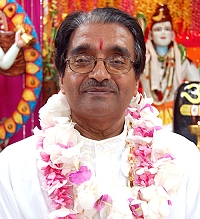

From the teachings of Paramacharya of SWAHA, H.H. Pt. Hardeo Persad
As devotees, we participate in many forms of worship: yagyas, prayers, rituals and discourses. Each has its place in the spiritual journey. Yet, beyond devotion and ritual lies an equally important dimension: philosophical understanding.
Philosophy enables us to understand why we worship, to internalize the teachings of our tradition and, ultimately, to put them into practice in our daily lives.
As we observe Shree Ganesh Utsav, it is therefore worthwhile to look beyond the external rituals and reflect on the deep significance of Shree Ganesh and what this sacred observance asks of us.
Shree Ganesh and the Unity of the Individual and the Universal
The traditional image of Shree Ganesh carries profound philosophical meaning. His elephant head represents the macrocosm, the vast, universal reality, while his human body represents the microcosm, the individual human being.
The ultimate state of spiritual realization is the recognition that these are not separate. The individual Self is one with the Universal Self.
Shree Ganesh therefore symbolizes non-duality, the transcendence of the perception that we are separate from the Divine, from one another and from the universe itself.
This is the deepest objective of our spiritual journey: to move beyond the perception of separation and realize the unity that exists at the heart of existence.
Overcoming Avidya: The Root of Our Afflictions
One of the greatest obstacles on this journey is avidya, or ignorance.
According to Vedantic philosophy, five mental afflictions affect human beings: avidya (ignorance), asmita (ego), raga (attachment), dvesha (aversion) and abhinivesha (fear of death or clinging to life). Of these, avidya is fundamental, because the others arise from it.
It is because of ignorance that we perceive ourselves as separate. We constantly divide our experience into “I” and “that,” “I like this,” “I dislike that,” “I want this” and “I do not want that.” We become caught in the ongoing cycle of subject and object, attraction and aversion, desire and rejection.
Shree Ganesh, as the Lord of Wisdom, represents the wisdom that can help us overcome the ignorance.
The worship of Shree Ganesh should therefore be an opportunity to cultivate Viveka, the power of discernment. Viveka enables us to distinguish between the real and the unreal, between what is right and what is wrong, and between what is truly important and what is merely temporary. Without the discriminative power, we remain vulnerable to the disturbances of the mind.
The Journey Begins Within
The story of Shree Ganesh being created by Devi Parvati and placed to guard the entrance to the cave also has a deep yogic significance.
From a yogic perspective, the cave represents the Muladhara Chakra, the starting point of the spiritual journey.
Before one can progress towards the highest realization, one must cultivate self-restraint, discipline and positive virtues. These qualities prepare us to enter the inner cave and undertake the journey towards Self-realization.
This is why the spiritual journey cannot remain external. We may worship Shree Ganesh, offer prayers and participate in sacred rituals, but the real transformation must take place within ourselves.
It is easy to seek the Divine with a list of everyday problems and ask for each one to be resolved. Yet, we should always keep sight of the larger purpose of our worship.
The question is not simply, “Can Shree Ganesh solve my problems?”
It is: “Can my worship help me develop the wisdom, discernment and inner strength to understand and navigate those problems?”
Our everyday difficulties are part of life. What we truly need is the wisdom to respond to them appropriately.
From Ritual to Transformation
The worship of Shree Ganesh should not end when the rituals end. It should lead to a transformation in the way we think, behave and relate to the world.
We need to ask ourselves: Are we developing the ability to distinguish between what is real and unreal? Between right and wrong? Are we prepared to stand for principle? This is particularly important not only for individuals but for society as a whole.
When prejudice, bias, division and partisanship influence our decisions, the need for viveka becomes even more urgent. We must cultivate the wisdom to see clearly, to act according to principle and to make choices that serve the greater good. As the saying goes, we must stand for something, or we may fall for anything.
Therefore, Shree Ganesh Visarjan should not simply mark the conclusion of a period of worship. It should mark a renewed commitment to inner change.
The Meaning of Visarjan
The word Visarjan refers to immersion. When the murti of Shree Ganesh is immersed in the ocean, the physical form returns to the greater body of water from which it came. This ritual carries a profound spiritual symbolism.
The individual Atman is not separate from the Universal. The immersion represents the movement from the perception of individuality and separation towards unity and non-duality. As Shree Ganesh is immersed, we are reminded of the ultimate spiritual realization: “I am one with my Master.”
The external form is returned to the universal, reminding us that the Divine we worship outside is also present within us. The journey, therefore, is not outward but inward.
Begin the Journey
The sacred celebration of Shree Ganesh is an invitation to begin that internal journey. Every journey begins with a single step. Our physical offerings and external acts of worship can be that first step, but they must lead us towards something deeper.
The path is one of duty, discipline, concentration and wisdom. As we perform our duties with sincerity, we develop better concentration. Through that concentration comes yoga, and from yoga comes wisdom, the wisdom represented by the Ganesh principle. Then our celebration becomes more than an outward observance. It becomes an eternal celebration within.
The true purpose of Shree Ganesh Utsav and Visarjan is, therefore, to remind us of who we truly are: the Universal, Eternal Self within each of us.
