
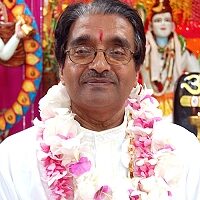

An Interview by Pt. Adesh Maraj with Paramacharya of SWAHA H. H. Pt. Hardeo Persad
Interviewer Pt. Adesh Maraj: Guruji, what was your inspiration that influenced changes to after death ceremonies, to modify the practices from the long-established tradition to five days?
Paramacharya: It’s about 59 years I’ve been actively practising as a pundit. With the passing of time, different circumstances and different experiences prompted me to analyze and question whether we need to do what we are doing in the way that we are doing.
Whatever we do, all our practices, have their genesis in India. They all started in India, thousands of years ago. One would understand that the social conditions, economic conditions, and all the different conditions that existed in society way back then would be different from what they are today.
Scriptures tell us that, with time and circumstances, we must make adaptations and adjustments to suit. But before we make any kind of adjustments, we have to understand the reason why we are doing what we are doing.
Being a pundit for all these years, I would try to do everything possible to enhance what we do. There is the ritualistic way and then there’s the inner meaning. I’ve been preaching the inner meaning of Pitri Yajna.
We have received the body of laws and practices from the ancestors. We need to understand them, maintain them, enhance them where possible, and pass them on to future generations to perpetuate these values, but they must also be based upon time and circumstances.
Interviewer: What would your advice be to practising pundits who say that Garuda Purana has certain things stated quite literally and that scriptures should be taken just as they are?
Paramacharya: The mysteries of the world can be unravelled in three ways. There’s the experimental outlook, cosmological outlook and metaphysical outlook.
The experimental outlook can be classified as the story itself. It provides a certain degree of comfort. But therein also lie certain cosmological principles that we need to apply to man’s life.
The scriptures teach us lessons through the lives of great men who lived in the past. But these great men lived in a different time and different circumstances compared to us. Therefore, we have to go to the underlying principle that governs everything.
The metaphysical is the application of scriptures to every individual. In every scripture, in all religions, you have to understand the deeper meaning that is applicable to the person in a metaphysical sense.
Why do you take scripture literally? For instance, in the Garuda Purana, they say that when the husband dies, the wife is supposed to burn herself. Burning yourself doesn’t imply sitting on the pyre and committing suicide. Scriptures teach that if you want to attain liberation in this lifetime, you should live a life of self-discipline, a life of yoga. So, in other words, you burn yourself in the fires of self-discipline, not physically.
Garuda Purana also says that when you die, they will dip you in hot oil. But you cannot take this literally. The world itself can be compared to a cauldron of hot oil. Every one of us, time and again, are dipped in hot oil based upon karma.
So interpretation of scriptures is very, very important. If you can interpret it, you will get a deeper meaning, a deeper understanding.
The Garuda Purana was written in the Middle Ages. In every age, every circumstance, people document their practices.
Interviewer: Garuda Purana says the soul leaves the body and goes through 16 villages. How should we understand this?
Paramacharya: I’ve always asked the question: where are these villages? Somebody in Trinidad dies, somebody dies in Canada, somebody dies in India—where are the 16 villages? What is the meaning of this?
I like to go to Bhagavad Gita, Chapter 2. Verse 23 says that fire cannot burn the soul, water cannot wet the soul, wind cannot dry it, and weapons cannot cut it. The soul is unwettable, uncuttable, undyable. The soul cannot be burned. You burn the body. The five elements, fire, water, earth, wind and ether, have no effect on the soul.
Bhagavan Krishna says the soul is eternal, all-pervasive, immovable, immutable, unchangeable and everlasting. Now, the soul is immovable, but you’re saying the soul is passing through 16 villages. The soul does not move from place to place.
So, what are the 16 villages? It all goes back to the composition of the human. We have three bodies: the physical body, the astral body and the causal body. The physical body dies. We are accustomed to saying the soul leaves the body, but Bhagavan says the soul is immovable.
The 16 villages refer to the astral body made of 16 tattvas: five karma indriyas, five gyaan indriyas, the five tan matras and the mind. The sages refer to the body as a city, the tattvas as villages, etc. So, I try to understand what the scripture means.
The physical body disintegrates. The astral body disintegrates. The soul does not.
The soul can be compared to a circle of infinite circumference but with the centre in the body, to put it simply. The soul is no different from the Super Soul, but with the centre in the body.
When the physical disintegrates and the astral disintegrates, what we say is that the centre shifts. If you have an infinite circle, the centre is anywhere and everywhere, mathematically speaking. So there is no physical movement of the soul.
Interviewer: So, what then is the purpose of the rituals and the offerings made after someone dies?
Paramacharya: When somebody dies, their karma takes them where they must go. The rituals are repayment of the debts of gratitude that we owe to all the ancestors. Scriptures tell us you have to repay the five debts: debt to God, debt to the rishis, the ancestors, society and lower forms of creation. Performing these karmas on a daily basis is what we call nitya karma. I owe these debts. I have to repay them on a daily basis. When somebody dies, I’m repaying these five debts. As long as we live, we owe these debts. So, I do Krishna puja, I read, I pay obeisance to the ancestors, people partake of meals, and the food that I put outside is for the lower forms of life. So I’m repaying my five debts of gratitude.
Interviewer: Garuda Purana gives different periods for the observances depending on caste, yet most people observe 13 days. How do you reconcile this?
Paramacharya: The question is, does the soul have a caste? The soul has no name, no form. It’s beyond all these limitations. So who are you doing this for? Not the soul. If I owe a debt of gratitude, I can repay it in this time. My firm belief is that the body has gone, but the Atma, the soul, is always existing.
Interviewer: What would your response be to the pressures devotees face from elders who tell them that these are the final rites and must be performed in the “right way”?
Paramacharya: What is the right way? The right thing is to fulfil the obligation that you have, whether in one day, whether in five. People ask me, why five days? There is the cremation, then disposal of the ashes, the shaving, and the full shraddha. It’s not missing anything out, but rather doing it in a shorter space of time.
But the main reason for doing the after death ceremonies in five days is because I believe the soul doesn’t die, and all these practices are not for the soul. They are so I can repay my debt of gratitude.
Interviewer: What would you like viewers to take away from this discussion?
Paramacharya: I firmly believe in what Albert Einstein said: there are two things that are infinite: one, the universe, and two, human stupidity. He said, “I’m not sure about the universe.”
To our viewers, I keep saying: you may fully agree with me, but keep your mind open, analyze. Change must take place, but we don’t change the philosophy that is behind it. It’s the methodology that could change based upon time, place and circumstances.
(The interview is available on IETVTT’s YouTube channel.)

GURUPRASAD PANAMALAI
Thanks for your article. It is commonly believed based on what our Hindu Scriptures including Garuda Purana mention that when a person dies, the soul leaves his/body. But you mention that the soul is immovable. Kindly clarify. Best regards🙏🙏