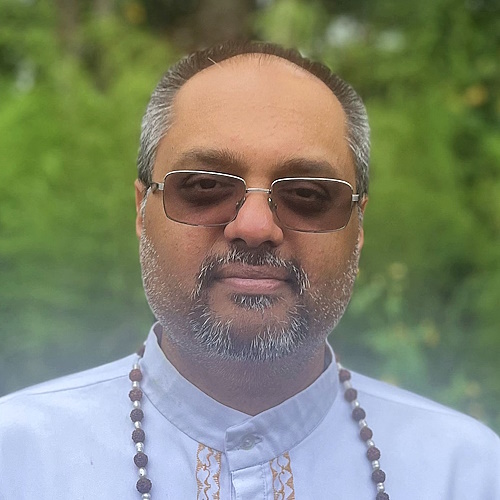


From the teachings of Pt. Dr. Umesh Persad, Spiritual Advisor, Shiva Shakti Mandir of Marion Oaks, Fl., USA
One of the most profound teachings of Adi Shankara, the great philosopher and exponent of Advaita Vedanta, concerns the transformative power of good company. He taught:
“From satsang, the association of good people, comes non-attachment; from non-attachment comes freedom from delusion; freedom from delusion leads to self-settledness; from self-settledness comes jeevan mukti, liberation.”
In another celebrated verse, Shankara issues a powerful reminder:
“O madmen, why are you so engrossed in thoughts of wealth and relationships? Is there no one to guide you? There is only one thing in the three worlds that can save you from this ocean of samsaara. Get into the boat of satsang, the association of good people. There is no time to waste.”
This teaching points to the very beginning of the spiritual journey. It reminds us that liberation does not begin with complex rituals or intellectual study, but with keeping the company of those who inspire us towards truth.
What is Satsang?
The word satsang is derived from two Sanskrit words: sat, meaning “truth” or “that which is real,” and sanga, meaning “association” or “company”. Satsang therefore refers to the company of truthseekers, saints, sages and spiritual aspirants, where the nature of reality is discussed, contemplated and experienced.
More than simply gathering with religious people, satsang is an environment that elevates the mind and directs it towards higher ideals. It provides an opportunity to reflect on life’s deeper questions: Who am I? What is the purpose of life? What is the nature of reality? How can lasting peace be attained?
The Ramayana identifies satsang as one of the first steps on the path of devotion. It is followed by a love for listening to religious teachings and then by selfless service to the true Guru. Together, these practices lay the foundation for spiritual growth.
The Importance of Right Association
Human beings are profoundly influenced by their surroundings. The mind absorbs what it is repeatedly exposed to and gradually takes on those qualities. Thoughts become habits, habits become character, and character shapes destiny.
For this reason, satsang begins not merely with physical association but with mental association. Whatever occupies the mind becomes our reality. If the mind dwells constantly on material concerns, competition and worldly desires, those tendencies become stronger. If it dwells on wisdom, devotion and truth, it becomes uplifted and refined.
Through holy association, we develop vivek: discernment, right judgment and clear vision. Viveka enables us to distinguish between the permanent and the temporary, the essential and the trivial. Most importantly, it helps us understand not only the nature of the world, but also the true nature.
Even when physical satsang is not available, the scriptures themselves become a form of satsang. Religious texts serve as guides, preserving the wisdom and experiences of enlightened souls across generations.
From Satsang to Non-Attachment
According to Adi Shankara, the first fruit of satsang is nissangatva, detachment.
Detachment does not mean indifference or withdrawal from life. Rather, it is a deep understanding of the nature of existence. It is the recognition that all things in the physical world are temporary, limited and subject to change.
When this understanding matures, we are able to enjoy the world without becoming bound by it. We appreciate relationships, possessions and experiences while recognising that none of them can provide permanent happiness or fulfilment.
Without an understanding of this, attachment naturally gives rise to desire. Every desire leads to one of only two outcomes: either it is fulfilled or it is not. When our desires are fulfilled, pride, ego and possessiveness may arise. When they are frustrated, anger, disappointment and sorrow often follow.
Thus, much of human suffering revolves around the eternal cycle of wanting, obtaining and loss.
Good association gradually frees us from the cycle of bondage by giving us a better perspective on life.
Self-Settledness and Liberation
As attachment reduces, delusion begins to recede. The mind becomes calm, clear and less disturbed by external circumstances. This leads to what Shankara calls nischalatattvam, self settledness.
A self-settled person is inwardly anchored. Their peace does not depend on changing situations, praise or criticism, gain or loss. They have discovered a deep source within themselves.
When this state becomes firmly established, it culminates in jeevan mukti, liberation while living. Such a person remains fully engaged in the world yet is no longer bound by it. They have transcended the cycle of suffering born of ignorance and attachment.
The Three Pillars of Spiritual Growth
Three essential supports help us move forward on the spiritual path.
The first is satsang, the guidance and inspiration that comes from holy company.
The second is the study of scripture. The religious texts preserve the wisdom and experiences of those who have travelled the path before us. Through daily study, they help us maintain right vision and increase understanding of divine nature.
The third is the internal guru: the intellect purified and enlightened by spiritual practice.
Initially, our intellect may be clouded by ignorance, attachment and misunderstanding. Through satsang and scriptural study, however, the internal guru begins to manifest. Gradually, the capacity for discernment strengthens, enabling us to understand the deepest truths revealed by the sages.
The Role of the Guru
The guru is often described as the remover of darkness. The word itself signifies one who dispels ignorance and reveals truth.
The guru provides guidance, inspiration and clarity. More importantly, the guru points the seeker towards direct spiritual experience.
Scriptures record the experiences of realised souls, but these teachings become truly meaningful only when they resonate with our own experiences. The guru helps bridge this gap between theory and realisation.
Through discipline, practice, study and reflection, the seeker gradually develops the ability to recognise spiritual truths within themselves.
Seeing Brahman Everywhere
A profound illustration of spiritual vision is found in a well-known mantra recited before meals:
“Brahmarpanam Brahma Havir, Brahmagnau Brahmana Hutam;
Brahmaiva Tena Gantavyam, Brahma Karma Samadhina.”
This verse teaches that Brahman, the Supreme Reality, is the offering, the one who offers, the divine fire into which the offering is made and the act of offering itself.
In havan, there appears to be a devotee, an offering and a divine fire. At the highest level of understanding, however, all are manifestations of the same Supreme Reality.
The individual who recognises this truth and performs all actions with this awareness gradually attains Brahman.
The Unity Behind All Forms
Until we develop this highest vision, we tend to see separation and diversity everywhere. Yet the sages teach that behind all names and forms is one underlying Reality.
Ganeshji represents the Lord of all categories and beginnings. Durga Devi represents the Supreme Power that transcends all limitations. Shivaji embodies pure auspiciousness and the union of stillness and motion. Vishnu Bhagavan is the omniscient divinity. Shree Raam is the divine light that shines within. Hanumanji represents the state beyond limited thought. Krishna Bhagavan symbolises the infinite mystery that cannot be grasped by the senses.
Though the forms appear different, their essence remains one.
At the highest level of spiritual realisation, all distinctions dissolve into the experience of unity.
The Goal of the Spiritual Journey
The true Guru leads the seeker towards the experience of this unity. The purpose of satsang, scripture and spiritual practice is not merely intellectual understanding but transformation.
The Guru offers a glimpse of the highest reality and inspires the seeker to strive towards it. Through dedicated effort, good living and divine grace, the spiritual aspirant gradually moves towards the state of jeevan mukti, liberation while living.
This is the culmination of Adi Shankara’s teaching: from satsang comes wisdom, from wisdom comes freedom, and from freedom comes the realisation that the One Reality we seek has always been within and around us.
