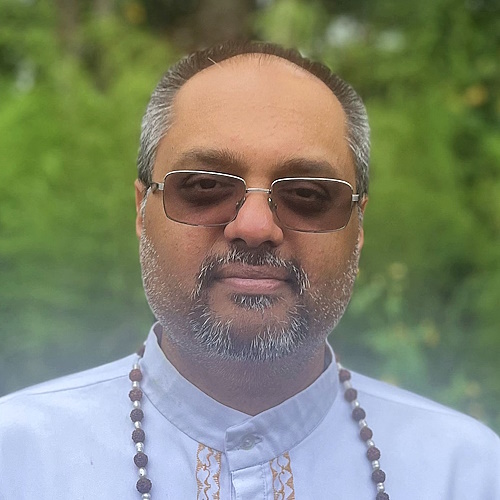

From the teachings of Pt. Dr. Umesh Persad, Spiritual Advisor, Shiv Shakti Mandali of Marion Oaks, Fl, USA
The Bhagavad Gita reminds us that the world is both impermanent and filled with challenges. Pleasure and pain, gain and loss, success and disappointment are constant polarities in human life.
Yet the scriptures also teach that true and lasting peace is possible. Spiritual teachers describe this journey as a gradual movement through several stages of internal peace, each representing a deeper stage of spiritual maturity.
Stage One: Dharma, Living Righteously
The first stage of peace arises when a person strives to live according to dharma, the path of righteousness.
At this stage, one consciously tries to:
- perform right actions
- avoid wrongdoing
- and live with honesty and responsibility.
Many disturbances of the mind arise when we act against our conscience. By aligning our actions with dharma, we begin to experience a sense of inner stability.
Stage Two: Nishkaama Karma, Freedom from Selfish Desire
The second stage emerges when actions are performed without selfish motives.
Instead of acting only for personal gain or recognition, the individual begins to serve with a spirit of detachment and offering.
This is known as Nishkaama Karma, action performed without attachment to the results.
Such an attitude brings greater peace because the mind is no longer constantly agitated by expectations and disappointments.
Stage Three: A Life Centred on the Divine
At the third stage, the individual’s primary focus shifts from worldly pursuits to spiritual realization.
The seeker becomes a sincere saadhaka, someone whose life revolves around devotion, self-discipline and the search for truth.
The mind gradually becomes calmer as desires diminish and spiritual aspiration grows stronger.
Stage Four: Samaadhi, Internal Absorption
The fourth stage of peace is experienced in samaadhi, a state of deep meditation in which the mind withdraws from external distractions.
In this state:
- the senses become quiet
- mental agitation subsides
- and the awareness turns inward.
Samaadhi is not sleep or unconsciousness; it is a state of profound clarity and stillness.
Stage Five: The Vision of Unity
The highest stage of peace arises from the Advaitic vision, the realisation that the same Divine presence is in everything.
At this stage, the seeker does not perceive God only during meditation or prayer. The Divine is recognised everywhere:
- within oneself
- within other people
- and throughout the entire universe.
This is the vision described in the Upanishadic teaching “Satyam, Jñaanam, Anantam Brahma.”
Such awareness brings a peace that does not depend on external circumstances.
The Secret of True Happiness
The Sanskrit words for happiness and suffering offer an interesting insight.
- Sukha suggests openness and expansion.
- Dukha suggests restriction and contraction.
Whenever the mind becomes narrow, self-centred and attached only to personal desires, suffering arises. But when the heart expands in compassion, service and spiritual awareness, happiness naturally follows.
Moving Toward Peace
These five stages of peace remind us that spiritual growth is gradual. Each stage builds upon the previous one.
The journey begins with righteous living, deepens through selfless action, matures through devotion and discipline and culminates in direct awareness of the Divine presence everywhere.
This ultimate realisation brings the peace that all human beings seek, a peace that is steady, expansive and enduring.
