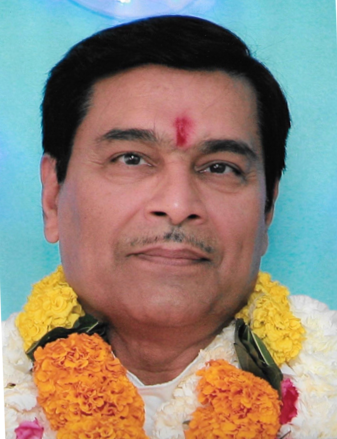
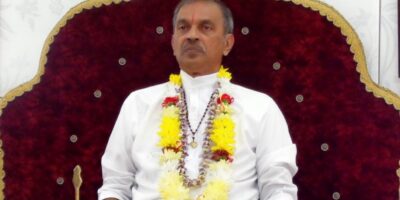
From a satsang with Pt. Balram Persad, Spiritual Leader, SWAHA Om Shakti Mandali
As we celebrate the auspicious observance of Shivraatri, our reflections naturally turn toward one of the most profound qualities symbolised by Bhagavan Shiva: vairaagya or spiritual dispassion. Lord Shiva embodies vairaagya: the quiet strength of detachment that leads the seeker from bondage to liberation.
This principle is beautifully illuminated through scripture, dialogue and lived experience.
The Lord Who Gives
In an insightful exchange between Narad Muni and Bhagavan Shri Ram, Narad hesitates to ask for a boon. Shri Ram gently reassures him:
“There is nothing in this entire universe so dear to Me that I would not give to a deserving devotee.”
This declaration reveals a central divine quality: non-attachment. The Lord clings to nothing, yet possesses everything. In that moment, Narad asks, and his request is granted, affirming the eternal truth: God is the giver; all beings are seekers. This generosity is not merely an act. It is the fruit of absolute detachment.
What Is Vairaagya?
Vairaagya is often misunderstood as abandonment of the world. In truth, it is mental detachment, not physical withdrawal. It does not demand that one flee society, family or duty, but that one turn the mind inward rather than remain enslaved to external cravings.
The scriptures remind us:
- The world is one of birth and death, union and separation.
- Everything that arises will eventually dissolve.
- What is perishable can never grant lasting fulfilment.
Thus, vairaagya arises from clarity, not aversion.
Living in the World, Rising Above It
We are encouraged to be like the lotus:
- Its roots are in the mud.
- Its stem passes through water.
- Yet its flower blooms untouched above both.
Worldliness and material life are necessary, but they are not the ultimate goal. As the sages say: The finite can never satisfy the infinite.
Just as physical eyes cannot behold the cosmic form without divine vision, worldly pleasures cannot fulfil the hunger of the soul.
Vairaagya in Everyday Life
Vairaagya is not foreign to us, it is practised daily, often unconsciously:
- A student gives up leisure to succeed in examinations.
- A worker restrains spending to achieve financial stability.
- A devotee leaves the comfort of home to attend worship.
Each act reflects a simple truth: To gain something higher, one must release something lower. Spiritual progress demands the same principle: discipline, commitment and devotion.
Scriptural Examples of True Detachment
The scriptures are rich with living examples of vairaagya:
- The Gopis of Vrindavan, whose joy lay solely in Krishna’s presence.
- Lakshman, who renounced palace life to follow Shri Ram into the forest.
- Sita Devi, who abandoned royal luxury to share her Lord’s exile.
- The Vanaaras, who relinquished heavenly comforts to serve the divine mission.
Their happiness was not in possession, but in proximity to the Divine.
The Four Stages of Vairaagya
Spiritual dispassion unfolds gradually:
- Initial restraint: Attempting to limit indulgence.
- Partial control: Attraction remains, but is moderated.
- Sense control: The senses are restrained, though likes and dislikes persist.
- Complete detachment: The mind is free of attraction, aversion and agitation.
Correspondingly, vairaagya may be mild, intense or complete; each stage marking spiritual maturity.
Why Lord Shiva Represents Vairaagya
When we bow before Bhagavan Shiva, seeing the Ganga, the third eye, the bull, the serpent, we are not merely venerating a form. We are contemplating a principle:
- Mastery over desire
- Freedom from ego
- Internal stillness amidst chaos
- Non-attachment to name, form and possession
We have all let go of many things in life: childhood habits, toys, comforts. Yet some attachments still linger, generating stress, confusion and sorrow.
Vairaagya asks us:
- What am I still holding onto?
- What is holding me back?
- What must I release to grow?
One cannot cling to the world and expect to understand the Divine fully. To receive something higher, we must be willing to offer something lower.
May Bhagavan Shiva guide us toward that freedom: where detachment brings peace and renunciation becomes joy.
