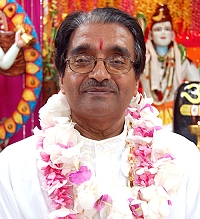
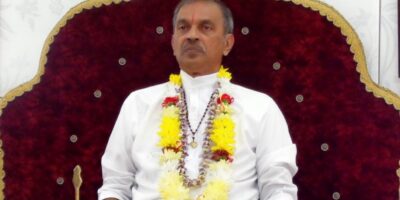
From a satsang with Paramacharya of SWAHA, H.H. Pt. Hardeo Persad
At first glance, Sanaatan Dharma may appear as a polytheistic tradition, with various Gods, Goddesses, forms and mythologies. Yet at its philosophical core is a profound and uncompromising truth: there is only One Supreme Reality. The many deities of Hinduism are not distinct Gods, but symbolic manifestations of that One, known as Brahman, the infinite, indescribable and eternal substratum of existence.
Brahman has no beginning or end, no form or colour, no gender or limitation. It is beyond description, yet it is the very essence through which all things exist. The human mind is conditioned by name, form, space, time and circumstance. In order to relate to the formless Absolute, Hinduism employs symbolism and personification. Among the most profound of these personifications is Bhagavan Shiva.
The Gunas and the Hindu Trinity
All existence functions under the influence of three fundamental qualities or gunas:
- Sattva (purity, harmony, spirituality)
- Rajas (activity, passion, material desire)
- Tamas (inertia, stillness, dissolution)
These gunas influence every individual at all times and operate across ethical, psychological and spiritual dimensions of life.
When Brahman associates with Sattva, divinity is personified as Bhagavan Vishnu, the Preserver.
When Brahman associates with Rajas, it manifests as Brahmaji, the Creator.
When Brahman associates with Tamas, it manifests as Bhagavan Shiva, the Reabsorber.
This does not imply hierarchy or separation. Brahma, Vishnu and Shiva are not different Gods, but different functional expressions of the same Supreme Reality. Among them, Shivaji occupies a unique and deeply philosophical space: he symbolises stillness, transcendence, non-differentiation and dispassion.
Why Symbolism Matters
Hinduism understands that the human mind thinks in images. A single form can convey truths that thousands of words cannot. Thus, every aspect of Lord Shiva’s form is intentional, each emblem offering guidance for contemplation and transformation.
The ultimate purpose of meditating upon Shiva is not external worship alone, but self-realisation. As the scriptures declare: Aham Brahmasmi; I am Brahman. To contemplate Shiva is to rediscover one’s own divine essence.
The Substratum of Existence
Bhagavan Shiva is depicted as white in colour. White is the source of all colours and the state into which all colours ultimately merge. In the same way, Shivaji represents the substratum of creation, that from which everything arises and into which everything dissolves.
Meditating upon this symbolism leads to a powerful realisation: If Shiva exists in all things, then Shiva is within me. There is nowhere that he is not.
This understanding dissolves the illusion of separation and leads to the awareness of oneness.
The Three Eyes: The Eternal Witness
Lord Shiva’s three eyes represent perception of the past, present and future. The third eye is not physical; it is the eye of higher awareness. It symbolises Shivaji as the eternal witness, the indwelling consciousness that sees all actions, thoughts and intentions.
Nothing is hidden from Shivaji. He cannot be deceived, bribed, threatened or escaped. He is simultaneously the witness, the judge and the dispenser of cosmic justice. This symbolism is not meant to instill fear, but moral clarity; it is a reminder that integrity begins within.
Matted Locks and the Flowing Ganga: Discipline and Devotion
Shiva’s matted locks (jataa) symbolise mastery over the ten vital airs (pranas) that govern bodily and metabolic functions. This mastery allows Lord Shiva to remain in uninterrupted meditation for ages, undisturbed by physical impulses.
From these locks flows the Ganga, not merely as a river, but as a symbol of bhakti, the uninterrupted stream of pure, selfless devotion. True devotion does not arise from ritual alone, but from discipline, dispassion and internal control.
Without mastery over the body and mind, devotion remains mechanical. With discipline, devotion becomes transformative.
Vairaagya: The Spirit of Dispassion
Bhagavan Shiva epitomises vairaagya, the ability to renounce what is unnecessary and to remain untouched by worldly fluctuations. This state is not limited to any religion or culture; it is a universal spiritual necessity.
Rituals without dispassion do not lead to liberation. True renunciation does not mean abandoning life but freeing oneself from bondage to desire.
Nandi the Bull: Mastery Over Desire
Bhagavan Shiva’s vehicle, the bull Nandi, symbolises lust. Shivaji is one who has brought it under control. When desire dominates the mind, devotion collapses. When desire is mastered, the mind becomes fit for spiritual ascent.
The Serpent: Time, Ego and Kundalini Shakti
The serpent adorning Bhagavan Shiva carries multiple layers of meaning:
- Time (Mahakala): Shivaji is beyond time; time emanates from him. While the body is devoured by time, the soul remains eternal.
- Ego: The individual ego must be transformed and offered to the cosmic ego. Ego is not destroyed, but purified and surrendered.
- Kundalini Shakti: The serpent also represents dormant spiritual energy within every human being. When awakened gently through disciplined devotion, it rises through the chakras and unites with Shivaji, resulting in non-dual awareness and bliss.
Forced or aggressive awakening can lead to imbalance and suffering. Spiritual growth, like nature itself, unfolds gradually and patiently.
The Five Faces and the Primordial Sound
Bhagavan Shiva’s five faces: Ishana, Tatpurusha, Aghora, Vamadeva and Sadyojata, symbolise the five cosmic functions:
- Creation
- Sustenance
- Dissolution
- Reabsorption
- Grace (Anugraha)
From these five aspects emerges the primordial sound OM, the symbol of Brahman itself. Thus, the sacred syllable Om, contains all creation within it and stands complete as a mantra in itself.
From Ritual to Realisation
Sanaatan Dharma offers multiple levels of engagement: from ritual to philosophy, from devotion to knowledge. We must understand why we do what we do, which strengthens conviction, faith (shraddha) and spiritual depth. Ultimately, Shiva is not merely a deity to be worshipped, but a state of being to be realised.
