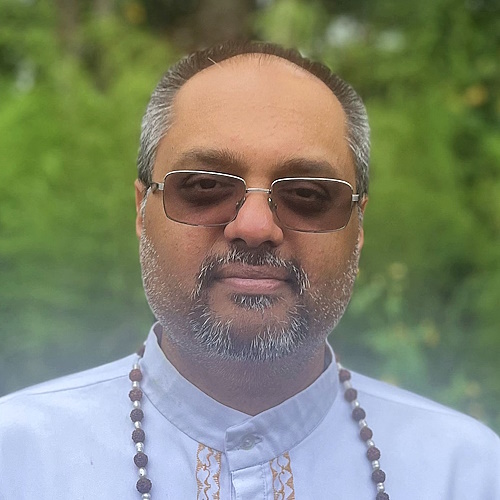

From a satsang with Pt. Dr. Umesh Persad, Spiritual Leader, Shiva Shakti Mandir of Marion Oaks, Florida, USA
Gita Jayanti commemorates the sacred moment on the battlefield of Kurukshetra when Bhagavan Shree Krishna imparted eternal spiritual wisdom to Arjuna. The Bhagavad Gita is not merely a dialogue; it is a universal guide to right living, inner clarity and spiritual liberation.
In the epic, Shree Krishna urges Arjuna to perform his svadharma, his duty as a kshatriya. Yet behind this call to action lies a profound spiritual principle: the truth of Advaita Vedanta.
- Advaita means “not two,” revealing the non-dual nature of reality.
- Vedanta is the culmination of the Vedas, that is, the philosophy of the Upanishads.
Its essence is expressed in the mahaavaakya, Tat Tvam Asi, “Thou art That.”
In Sanaatana Dharma, the Supreme is called Brahman, meaning “the Vast”, the Infinite. Brahman is described as sat–chit–ananda (existence–consciousness–bliss) and satyam–gyaanam–anantam (truth–knowledge–limitlessness). That Pure Existence is the Seer behind all seeing, untouched by time, place or object.
Shree Krishna reveals to Arjuna that his true nature, and the true nature of all beings, is the atman, identical with Brahman.
Just as waves arise from the ocean and return to it, all beings arise from Pure Existence and dissolve back into it. If everything is Brahman, then “I am That; all is That.”
An avataar like Śrī Krishna takes form fully aware of this Truth. We, in our delusion, do not recognise it. Therefore, He guides Arjuna—and by extension all of us—to live with awareness, fulfil duty and spiritualise everyday life. He teached that the hallmark of a realised soul is desirelessness.
Human beings are driven by desire. Shree Krishna asks: “Where can there be happiness for one without peace?” Happiness and sorrow alternate in a continuous loop; peace alone is lasting. Peace arises when desires cease, but desires arise from the senses. Life brings pleasant and unpleasant experiences, leading to suffering and a constant feeling of incompleteness. Religion offers a pathway to understand suffering, overcome it and attain lasting peace, but it requires commitment to a spiritual philosophy.
Shree Krishna also explains that the senses naturally chase after objects. Whichever sense the mind follows, that sense overwhelms the mind—like a ship swept off course by a storm on the high seas.
Thus, wisdom arises in the one who restrains the senses and stops being controlled by them. The mastery of the senses is the gateway to steady wisdom.
Shree Krishna describes the inner state of the realised being:
- What appears like “night” to the ignorant is “day” to the sage, meaning the sage is awake to spiritual truth and asleep to worldly illusions.
- Like the ocean steadily receiving rivers yet not overflowing, the realised one remains unmoved, even when objects of desire appear.
- One who abandons all desires, moves without attachment, and lets go of “I” and “mine” attains supreme peace.
This is the state of abiding in Brahman. Reaching it removes all delusion; dwelling in this consciousness even at the time of death leads to complete union with the Supreme.
Krishna’s teachings encourage a balanced spiritual life using our Head, Heart, and Hands:
Karma Yoga: The Path of Action. Selfless service purifies the mind. This is the yoga of the hands.
Bhakti Yoga: The Path of Devotion. Worship of the Divine in one’s chosen form cultivates concentration and purifies the heart.
Gyaan Yoga: The Path of Knowledge. Only true knowledge removes ignorance. Meditation also steadies the head and deepens insight.
We must choose our path: When we chase the world, we remain in saṃsaar, the cycle of joy and sorrow. When we turn toward God, we find lasting fulfilment.
On the sacred occasion of Gita Jayanti, may we reflect upon the Lord’s divine message. May we strive to control the senses, quieten desires, act with devotion and cultivate knowledge. In doing so, we gradually awaken from delusion and recognise the one Eternal Truth shining within all beings.
