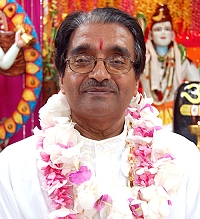
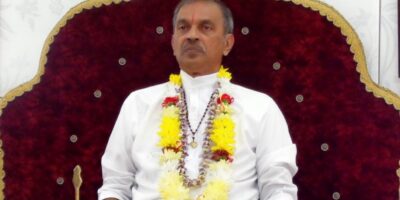
An interview with Paramacharya of SWAHA, His Holiness, Pt. Hardeo Persad, on SWAHA Viewpoint (ieTV).
Interviewer: What really is the essence of the observance of Gita Jayanti and how does one really tap into the Bhagavad Gita itself?
Paramacharya: The celebration was introduced to create an awareness of the Bhagavad Gita and to debunk the myth that the Hindu year comes to an end after Kaartik Nahaan. In fact, the Hindu New Year comes to an end around the month of March. Man must continue to pray at all times. Gita Jayanti is a very auspicious occasion, based on the birth of that sacred text. Many years ago, SWAHA Sri Raam Dhaam, through Pt. Maniedeo Persad’s initiative, introduced the concept of Gita International Forum, which created an awareness of the Bhagavad Gita. It is a very important text, part of Vedanta, which helps us to navigate life’s journey.
Q: Some people say that the Ramaayan is, not necessarily more important, but more popular in Trinidad and Tobago. Do you think that is the case?
A: Yes, historically, the ancestors brought with them the Ramaayan. They were ordinary, simple people and the Ramaayan is in a story form related by Goswami Tulsidas. In India, in the ancient past, when the Ramaayan was available in Sanskrit only, the language of Sanskrit was not well known beyond the scholars and so was not accessible by the ordinary person. Sant Tulsidas rewrote the Ramaayan in the language of the ordinary man and then, people could understand it and relate to it. It was the scripture that was close to their heart. The story of Shree Raam’s life is relatable, so many people could identify with the Ramaayan. They could see reflections of themselves in it. When the ancestors arrived in Trinidad, that scripture is what they held on to. It was easy to read, understand and sing. Then, it was dearer to their heart than the Gita, which was more of a philosophical scripture.
Like the Ramaayan, the Gita slokas could be sung also, but people were more accustomed to the chowpais in the Ramaayan. There aren’t many bhajans on the Gita, but there are bhajans on Bhagavan Shree Krishna himself. In the past, the Ramaayan and the Mahaa Bhagavat Puraan were the two most popular scriptures. Both have made a great impression and impact upon our people’s minds. Later on, with further development, intellectual and otherwise, more attention was placed on the Gita. We must understand that while the Gita is pure philosophy. It is also said that the Ramaayan is the essence of all scriptures.
- There is the feeling that we usually read the Gita at the time of death. In the bhandaara and shraad and so on, there is the gifting of the Gita.
G: I don’t think that it is associated with death only. If I may establish a point, if somebody dies, some people may read the Gita, some read the Garuda Puraana. Even in the Ramaayan, there is death, birth and all aspects of life. It teaches us how to deal with life’s circumstances.
A lot of commentary has been created around the Gita, yet still many people believe that the Gita is for intellectuals, whereas the Ramaayan is for the regular person. That is the perception.
- How does one make the Gita easier to understand?
- The Gita is such an impressive book; it is very deep. The more we read it, the deeper spiritual understanding we get from it. Those who read, teach and preach the Gita must have a certain level of anubhav, life experience. How can we speak about that which we have not yet experienced? Then it becomes just a literary exercise.
- So does it limit one from picking up the Gita and reading it?
It doesn’t. It is said that there are five daily debts that we must repay, one of which is the debt to the rishis. The recommended practice is that one should read the scripture on a daily basis. I have been recommending to teenagers and adults to read the Gita. As a spiritual discipline, you should try to read a verse or two of the Gita every day, and try to assimilate it based on your understanding at that point.
We must understand the meaning of the word. What is Bhagavad? Bhag, in one sense means ‘power’. We have heard the term, Bhagavan, a title given to the one who possesses 6 powers in all their fullness: spiritual majesty (aishwarya), righteousness (dharma), fame (yasha), prosperity (shri), wisdom (gyaan) and detachment (vairaagya). By studying the Gita, and practising its teachings, one can uncover these powers within ourselves.
- But not necessarily to become Bhagavan?
- If you uncover these six powers within you, then you are qualified to be called Bhagavan. In this sense, it does not mean the Supreme Purusha, but it is a title given to a person who possesses these six powers. The Vedas have said, “Aham Brahasmi”, I am Divinity. It does not refer to the physical body, but the atma (the soul or indweller). The study and application of the Gita helps one to tap into these six powers.
The Gita has 18 chapters. 1 + 8 is 9, which is a mystical number. It is the number of Devi, who symbolises the world of energy. There are nine factors present in the world of energy: space, time and causation; creation, sustenance and dissolution; sattva, rajas and tamas prakriti (the three states of existence). An analysis of the Gita reveals these nine factors. By identifying with them, one can go beyond the world of objects and attain to one’s true identity. It is instructive to note that the first chapter of the Gita is titled ‘The Yoga of the Dejection of Arjuna’. In today’s world of unemployment, crime and a deteriorating society that mentally affects us all, there is a need to preserve our sanity amidst all those negativities. Thus, the Gita is recommended reading.
By reading the Gita, we tap into the inner powers that exist inside, and with those powers we can become creative, Thus through the study and application of the Gita, we can recreate our world. It is not a literary exercise. It is a sadhaan. First of all, you get knowledge, but the deeper aspect of it is spiritual. Through the blessing of the rishis, there is a different energy and vibration that is manifested, and that is something that cannot be measured.
Q: Is that knowledge limited to Hindus?
A: Not at all. Everybody and anybody can study the Gita. As a matter of fact, there are many non-Hindus and non-Indians, who study and live the Gita. They are amazed by the power of the Gita. However, there are religious biases and prejudices that might limit it. The Gita’s teachings are universal. It cuts across all boundaries. Especially in these times we live in, where some are depressed, we need to make the Gita a part of our daily discipline and spiritual practice. That will take us out of various states of depression and bring about enlightenment. We can recreate ourselves. The Gita has 700 verses. Seven is the number of creation. There are seven chakras (energy vortices) within the body. By studying the 700 verses of the Gita, just as Tulsidas’ Ramaayan has seven chapters, we undergo a spiritual journey. Hinduism does not only look to an external God. but the scriptures are scientific, practical and deeply spiritual and we can lift ourselves to the highest levels of realisation by studying them, and go beyond the dualities of this world.
- There is a saying in the Gita, that man must lift himself by himself.
- It means self effort. We can’t just sit down and ask for God’s help. We must read, understand and practise. Teachings of the Gita are crucial. In the Ramaayan, there are many of the teachings of the Gita employed by Shree Raam.
Chapter 12 of the Gita speaks of the Yoga of devotion. The Gita also covers the other paths to the divine, karma yoga, sankhya yoga, gyaan yoga, dhyaan yoga, raaja yoga, and so forth, which appeal to persons based on their personal temperament. It is to the benefit of all that we should gravitate towards the Gita. We always say, “I need God, God doesn’t need me.” When we make sacrifices, there is hope and light to take us through the adversities of life. The Gita is such a light.

Vijay motilal
Bhagavad Gita is the users manual
For humanity.