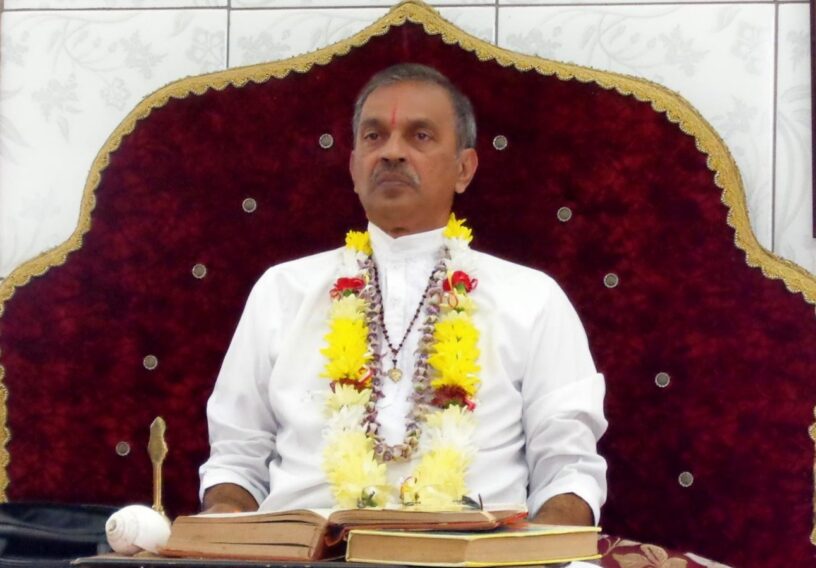

From a satsang with Pt. Gyandeo Persad, Spiritual Leader, SWAHA Sukh Shanti Bhakti Mandali
Sanaatan Dharma teaches that the Supreme Reality, Nirguna Brahm, is the Unmanifest, Absolute, Eternal One, beyond attributes, form and limitation. The eternal, undifferentiated Being is pure consciousness itself. Yet, out of divine compassion and cosmic necessity, the same Supreme assumes name and form as Saguna Brahm, manifesting in the world to restore balance and guide humanity according to the needs of each age.
When the Supreme aligns with sattva, the principle of purity, harmony and righteousness, It is known as Vishnu Bhagavan, the sustainer of the universe. The Lord manifests in innumerable forms, each bearing distinct names, symbols and purposes. Among these are the ten principal manifestations, the dasha avataars, which collectively reflect both the advancement of dharma and the spiritual evolution of life.
As we celebrate Phagwa in March it is fitting to remember the great devotee Prahlad, whose great faith gave rise to the fourth major manifestation: Narasimha Bhagavan.
Hiranyakashipu and the Illusion of Power
In ancient times lived the mighty king Hiranyakashipu. Through years of intense austerities, he obtained a formidable boon: he could not be killed by day or night, inside or outside his home, by man or animal, by celestial being or demon, nor by any weapon fashioned by human hands. Drunk with this apparent invincibility, Hiranyakashipu succumbed to arrogance and declared himself supreme.
Yet his own son, Prahlad, stood in quiet defiance; not through rebellion, but through devotion. Raised in the hermitage of Sage Narada alongside his mother, Prahlad absorbed spiritual wisdom from an early age and became a devoted worshipper of Vishnu Bhagavan. The child’s lips constantly echoed the divine name, his heart anchored firmly in faith.
The Divine Child
Hiranyakashipu’s fury knew no bounds. Consumed by hatred for Vishnu, whom he regarded as his enemy, the king could not tolerate his son’s devotion. Again and again, he attempted to destroy Prahlad. Each attempt failed, for Prahlad’s faith became his shield, and divine grace his defence.
In a moment of rage, Hiranyakashipu demanded of his son, “You claim your God protects you. Where is He?” Calmly, Prahlad replied, “God is everywhere.” Mocking him further, the king pointed to a massive pillar and asked, “Is your God in this pillar as well?”
At that very moment, the pillar burst open, and Vishnu emerged as Narasimha: neither man nor beast, appearing at twilight, at the threshold of the palace, fulfilling every condition of the boon. Thus, the Lord defended His devotee and re-established righteousness.
The Deep Message of Prahlad’s Faith
While the story of Prahlad is widely known, its relevance to our own lives must not be overlooked. It is a reminder of a child who stood steadfast against overwhelming odds. Prahlad’s faith did not falter, nor did his mind waver from the conviction that the Divine always shelters his devotees. He witnessed the grace and power of the Divine unfolding before him.
Nurturing Faith Through Experience
Just as Prahlad’s devotion was nurtured through spiritual exposure, so too must we ensure that our children experience spirituality in meaningful ways. Bringing them to places of worship, allowing them to witness pujas and yagnas, and introducing them to sacred stories from an early age helps cultivate an inner connection with the Divine. Faith, when rooted in experience, becomes resilient and transformative.
Prahlad’s purity of heart compelled the Divine to manifest and champion his cause. His life teaches us that steadfast devotion invites divine grace. When our own faith becomes as steady and sincere as his, we too open ourselves to the experience of the Divine in our lives.

Leave a Reply