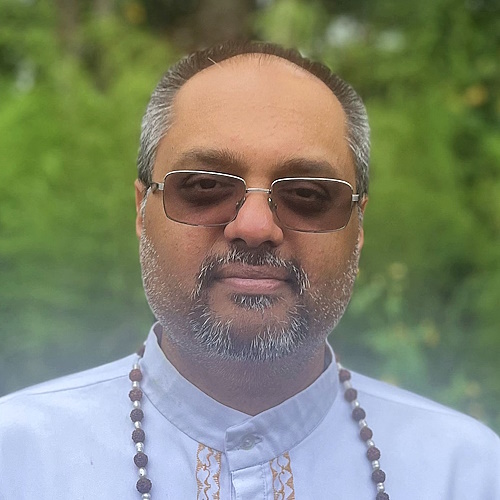
From a satsang with Pt. Dr. Umesh Persad, Spiritual Advisor, Shiva Shakti Mandir of Marion Oaks, Fl., USA
Most of us are familiar with the story of Prahlad that is traditionally associated with the vibrant festival of Phagwa, also known as Holi. In Sanaatan Dharma, however, festivals often carry multiple origin narratives. As human beings, we are naturally attuned to stories; they are among the most powerful ways of transmitting culture, values and tradition across generations. Yet these stories are rarely literal alone: they are vessels that carry deep spiritual meanings.
The Shree Krishna and Radha Devi Origin of Phagwa
One such origin story of Phagwa centres on Shree Krishna and offers a metaphysical perspective on the festival. According to this account, Shree Krishna’s mother gave Him various coloured powders and asked Him to take them to Radha and colour her. Through this playful exchange, their divine relationship unfolded, and this moment came to be celebrated as Phagwa.
The Inner Meaning of Krishna and Radha
When viewed through the lens of ancient Vedic science, particularly nirukta, the study of Sanskrit etymology, this story reveals a profound inner symbolism. The name Krishna holds multiple layers of meaning. Krish signifies attraction or existence, while na denotes ananda or Supreme Bliss. Together, Krishna represents that Supreme Bliss which irresistibly draws us toward it. At another level, krish also means existence and na means cessation, pointing to that which brings an end to the cycle of birth and death.
The name Radha is equally rich in meaning. Radha signifies one who is fortunate or fulfilled, and is rooted in aradha or aradhana, meaning worship or devotion. At a metaphysical level, it is said that Shree Krishna has the Lord’s maayaa (illusive) potency and the Lord’s chit (consciousness) potency, and the defender of these powers of the Lord is Radha. Shree Krishna and Radha Devi are eternally united as purusha and prakriti, pure consciousness and its dynamic expression.
From Radha to Rukmini: The Flowering of Devotion
Radha Devi is also understood as a manifestation of Sri or Lakshmi Maa, as is Rukmini. In this sacred progression, devotion embodied in Radha transforms into Rukmini, whose name means “to shine” or “to delight”, and who represents the shat sampath: the six forms of spiritual wealth. This transformation symbolises the movement from devotion to fulfilment and spiritual abundance.
Vrindavan: The Inner Celebration of Phagwa
The Skanda Purana speaks of both a physical Vrindavan and a spiritual Vrindavan, where Shree Radha and Krishna eternally play Phagwa. The sole difference between the two is the absence of demon slaying in the spiritual realm. This teaches us that the true celebration of Phagwa can occur within us only when the negative qualities symbolised by demons are overcome. When the coverings of maayaa are removed, the experience of Supreme Bliss becomes possible.
The Divine Leela of Concealment and Revelation
In the Divine leela, the Supreme performs two complementary functions: concealment and revelation. The Lord, in essence, plays hide-and-seek with Himself. By colouring one another, Krishna and Radha dissolve all distinctions, only to later remove the colours and reveal their true essence. This is the play of the One with Himself, expressed through His own shakti.
The Sacred Symbolism of Colour
The symbolism of colour in Phagwa is deeply significant. Each individual carries a unique “colour”, a distinct expression within the cosmic order. Every hue has its own beauty and purpose in creation. Through His leela, the Supreme Self beholds Himself in countless forms and colours, only to dissolve once again into oneness. On another level, the festival reminds us that to be truly coloured by the Divine, we must first empty ourselves, releasing ego, limitation and false identification.
Seeing Beyond Appearances
The journey begins with surrendering the belief that we are merely the body and mind. This mistaken identity lies at the root of human suffering. Even our perception of colour illustrates this truth: colour is subjective, dependent on wavelengths, sensory interpretation and mental construction. Some experience colour blindness; others perceive the same shade differently. This reveals that the world we experience is, in many ways, a creation of the mind rather than an absolute reality.
Phagwa as an Inner Realisation
Phagwa ultimately invites us to turn inward; to seek not the colouring of the external world, but the colouring of the Self. It celebrates the Divine play of concealment and revelation, while urging us to absorb not physical pigments, but the inner qualities of the Lord. Only through this realisation does the outer celebration of Phagwa attain its true and lasting meaning.

Leave a Reply