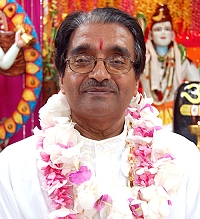
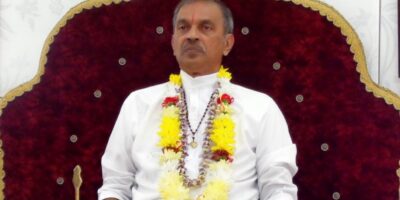
From a discourse with Paramacharya of SWAHA, H.H. Pt. Hardeo Persad
Every year, devotees are blessed to observe the sacred occasion of Guru Purnima—a special day in the spiritual calendar to reverently honour, worship and express deep gratitude to the Guru, the divine guide who enlightens the path of truth and self-realisation.
In Sanaatan Dharma, the Guru holds an exalted place, for it is through the Guru that the individual soul journeys from ignorance to wisdom, from bondage to liberation. The word Guru has two Sanskrit syllables: Gu, meaning darkness, and Ru, meaning the remover of darkness. Thus, the Guru is the one who dispels the shadows of ignorance and kindles within us the radiant flame of knowledge, as beautifully evoked in the line of the prayer:
“Tamaso maa jyotir gamaya.”
The tradition of Sanaatan Dharma recognises three main types of Gurus, each playing a role in the seeker’s life:
- Vidyaa Guru – The teacher of secular and scriptural knowledge. These are the educators who shape the intellect and understanding. One can learn from many such gurus throughout life.
- Kul Guru – The family priest, revered within the Sanaatani household, who performs sacred rites and upholds dharma through ritual guidance. Tradition encourages that one family holds to a single Kul Guru, to avoid conflicting spiritual information.
- Dikshaa Guru – The Guru who initiates the disciple into spiritual life. This is the one who opens the inner gateway to the divine. It is said that the Dikshaa Guru should be one, for initiation into the spiritual path is a sacred transmission that cannot be repeated in the same way, even if the Guru departs.
Guru Purnima especially celebrates the Guru who initiates us into spiritual life, for it is through such a soul that we are awakened to the higher Self. The Guru leads us away from the external path of duality (pravritti marg) toward the inward journey of renunciation and truth (nivritti marg), guiding us to recognise the indwelling presence of divinity—often symbolised by Bhagavan Ganesh, the internal Guru, the embodiment of wisdom itself.
In the Shree Raamcharitmaanas, Bhagavan Shree Raam instructs Shabari that the third stage of devotion is to worship the Guru’s lotus-like feet with pure, unselfish love.
The mystic poet Kabir Das once posed a thought-provoking question: “If both Guru and God stand before me, to whom shall I bow first?” His answer was steeped in deep reverence: To the Guru first, for it is he who showed me the path to God. Such is the sublime status bestowed upon the Guru—he is the bridge to the Infinite.
The Guru Gitaa, a sacred dialogue between Bhagavan Shankar and Devi Parvati, proclaims:
“The root of meditation is the Guru’s form;
The root of worship is the Guru’s feet;
The root of mantra is the Guru’s word;
The root of liberation is the Guru’s grace.”
In effect, liberation in this life and beyond rests upon the Guru’s merciful advice. The scriptures describe five special kinds of Gurus:
– The hidden one, who influences silently;
– The firm one, steadfast in wisdom;
– The loving one, full of compassion;
– The contented one, detached and fulfilled;
– And the one, who moves freely, and appears unexpectedly to bless the sincere devotee.
To find such a Guru is a blessing of lifetimes. To serve such a Guru with single-pointed devotion is the highest privilege.
On the sacred day of Guru Purnima, let us bow with humility and love at the feet of our Gurus, offering our gratitude for the light they shine upon our path. For it is through the Guru that we realise the Divine Self.

Guruprasad Panamalai
Thanks.
Krishnam Vande Jagad Gurum🙏.
DUSHYANT VISWANATHAN
Any events for gurupurnima, this year in trinidad ?