

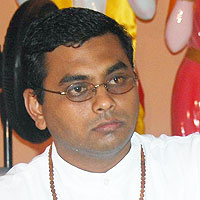
By Ronald Chuckaree, member of the SWAHA Education Board and SWAHA Sri Raam Dhaam, and an attorney at law.
(The article was originally published in the Divali Nagar Commemorative Magazine 2025, “Loka Sangraha, The Welfare of the World”.)
“Boys, always listen to your mother and do the right thing!” – my life’s motto was the parting words of goodly counsel uttered by my late father to my younger brother and me on the eve of his transition from this realm to the next.
This advice was more so an instruction to maintain Dharma with service and devotion to Mother and Father, particularly Mother. In my father’s command to live a respectable family life and to always act with integrity. In my 13 years with him, he was the epitome of all of this. At that time, little did I know, these were the foundations of what I now define as governance, social justice within the family unit.
The concept of Loka Sangraha, which translates to “Welfare of the World” in Sanskrit, draws from the Hindu thought and philosophy that emphasize the interconnectedness of all beings. At its core, it is about the collective wellbeing of society, and extends to governance and social justice in various facets of life.
In simple terms, governance encompasses the system by which an organization (in this case, the family) is controlled and operates, and the mechanisms by which it, and its people are held to account.
Family as the first institution in society serves as a microcosm of the larger society. In my opinion, one’s primary duty is the ensuring of a healthy, wholesome family whose members are part of a system that ensures justice, balance and fairness.
Governance in the family – a practical approach
Arguably, a high and idealistic thrust, in this context, Loka Sangraha, as a governance principle, from the perspective of my experience, encourages the practice of equality and respect, where each member of the family should be treated with dignity, regardless of age, gender or role. Decision-making should be participatory, involving all members in a way that reflects fairness and justice. Indeed, a departure from traditional modus operandi, where the elders alone made the decisions.
Naturally, it follows that the balance of power dynamics within the family is managed in a way that ensures no one is oppressed or left behind. The aim is that democracy becomes part of the governance structure of the family where every voice, from children to elders, has a place in the discussions and ultimately the decisions that shape family life. A practical approach to this is family meetings or check-ins, possibly over a meal, a lazy afternoon drive, a picnic. The purpose of this can simply be to see how everyone is doing, while creating a safe place to share experiences, challenges, and have open discussions, and voice disagreements in a homely environment.
Equality of access to all opportunities
Eons ago, in family traditions, it was the male offspring who enjoyed access to education and the birthright of inheritance, with females being left to learn home management in their formative years in preparation for marriage and to be taken care of by their husbands. While any contemporary school of thought may deem this as socioeconomic injustice, the thinking at the time was different.
With the passing of time, the shifting of roles and the further development of society, we now appreciate that proper governance in this area ensures that all family members are not left vulnerable to economic hardship, and that the family unit fosters an environment where all can thrive. In addition, there is equity of opportunity and equality of access to resources for all.
By looking at governance and social justice in the context of the family unit, we understand that the principles of Loka Sangraha are not just about macro-level policies but also deeply embedded in the way we interact with each other in the most personal and intimate settings, the family is the bedrock upon which a just society can be built, and practising these principles within the family can, in turn, ripple out into larger social structures.
The role of the elder “one”
Closer to home, governance within the family unit when a parent, more so, a father is absent, perhaps through death as in my case, the role of the eldest or elder child is both emotionally and practically significant. These duties often blend cultural expectations, religious customs and family dynamics. The eldest or elder child (hereinafter referred to as “one”) is likely to emerge as the single-handed support system: emotionally, economically and organically.
While a difficult concept to grasp, as the emotional anchor one must provide emotional support to younger siblings and the surviving parent. This includes helping siblings process grief, maintaining family unity and being a steady presence during a time of upheaval. This also means protecting the family’s reputation, wealth and tangible interests.
Management with integrity – a key element of social justice
Of equally critical importance is managing inheritance and legal affairs, as an attorney with several years in probate and estate planning practice, I deal with many families who are faced with the daunting task of probate of an estate or where the deceased died intestate, that is without a will, appointing an Administrator from amongst the Beneficiaries is an arduous task which can be emotionally exhausting and confusing without good legal advice. The legal obligations of obtaining the respective grant of representation, distribution of the estate, settlement of the deceased’s debts and the preservation of estate assets, require guidance, integrity and principle.
The central theme of Srimad Bhagavad Gita is Duty; without even thinking, the performance of such duty becomes clearer and more simplified by these clear governance systems which are easily identifiable and practically applicable to most.
Societal and social responsibility
Part of the value systems of all families should include a significant element of social responsibility, where family members are encouraged to act with a sense of responsibility toward society. It is noble to nurture a sense of justice and empathy in children, teaching them to care for others and the world around them; after all, “Vasudhaiva Kutumbakam” in Sanskrit translates to “The world is one family” in English. This ancient Indian saying conveys the idea that the entire world is interconnected and all people are part of a single global family. This involves, but is not limited to community service, helping neighbours and fostering a general sense of interconnectedness. Teaching children the value of sharing whatever they have with others, but even those who are less fortunate, is important in building a child’s sense of community. Children learn crucial social and emotional skills through sharing, including empathy, co-operation and how to navigate social interactions effectively.
In the same eons where daughters’ rights to their parents’ assets were limited, it was the same time in which this value system was most highly exemplified. The concept of community yagna, a general sense of sharing and caring within the community was commonplace. Therefore, educating children not only in academic knowledge but also in social consciousness and empathy is invaluable. They should learn about justice, equality and what it means to contribute to the world. This kind of education sets the foundation for larger-scale Loka Sangraha, as they grow up to be aware, responsible citizens, again tying back into the concept of community service.
