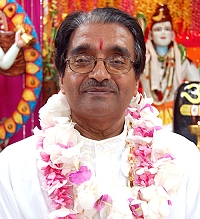
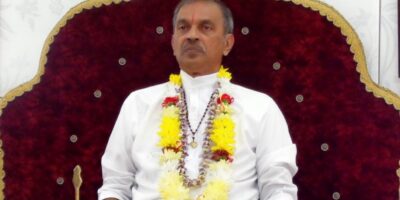
From a satsang with Paramacharya of SWAHA, Pt. Hardeo Persad
Sanaatan Dharma, as an ancient spiritual tradition, is rooted not only in devotion but also in profound philosophy. Its many captivating mythological stories are not mere tales — they are symbolic representations of eternal truths encoded within our scriptures. At the heart of Hindu worship lies a noble purpose: to realise and connect with the universal Divine that resides within every soul.
While numerous devotees engage in worship out of pure love and reverence — a beautiful and sacred act — Hinduism also encourages Gyaan Bhakti: devotion informed by understanding. We are urged to seek the why behind our rituals and the meaning within our prayers, so that our worship becomes not only heartfelt, but enlightened.
There are three traditional ways through which the mysteries of existence are revealed:
- The Mythological Outlook – where sacred stories express subtle truths through symbolism and parable.
- The Cosmological Path – where the universal laws of dharma, karma and the cycles of life and death are explored.
- The Metaphysical Approach – the deepest path, which reveals that every divine quality found in the universe also exists within the individual.
As the Vedas declare, “Yatha pinde, tatha brahmaande” – As in the microcosm, so in the macrocosm. That which exists in the vast universe also exists within each of us.
Hinduism is especially rich in imagery and symbolism, and each form of the Divine represents a universal principle found in nature and in the human experience. Among the most powerful symbols in Sanaatan Dharma is Devi, the Divine Mother — the Shakti or primordial energy from which all creation flows.
Devi manifests in myriad forms, each embodying a unique power:
- Durga is Icchhaa Shakti, the power of will.
- Lakshmi represents Gyaan Shakti, the power of wisdom and prosperity.
- Saraswati is Kriyaa Shakti, the power of sacred action and expression.
- Kaali personifies Kaal Shakti, the power of time and transformation.
Devi’s more esoteric forms are found in the Dasha Mahaa Vidyas, the ten great embodiments of transcendental knowledge. Each form reflects a deep spiritual truth:
- Kaali – the power of time
- Taara – the power of hunger or yearning
- Shodasi (Tripura Sundari) – the power of perfection and beauty
- Bhuvaneshwari – the power of space and knowledge
- Chinnamasta – the power of self-sacrifice
- Bhairavi – the power of dissolution
- Dhoomavati – the power of lack or adversity
- Bagalamukhi – the power of control and stillness
- Maatangi – the power of inner mastery and learning
- Kamala – the power of wealth and worldly grace
While there are many names — Ishwari, Parameshwari, Kaumari, Kalyaani, Katyayani and others — they all point to one ultimate truth: there is only One Shakti. Her forms may be many, but the Divine Energy is One.
All forms of energy — light, sound, heat, electromagnetism — are manifestations of the cosmic Shakti. In Hinduism, these energies are beautifully personified as goddesses. Yet, these divine forces are not external alone; they dwell within each of us.
When we worship Durga Devi, we awaken the willpower within. When we honour Saraswati Devi, we kindle wisdom and clarity. In connecting with Devi, we access and activate the dormant divine forces that lie in the temple of our own being. Thus, the purpose of prayer and spiritual practice is not external reward — it is inner transformation.
The path of Sanaatan Dharma is a journey inward. We must each seek and realise the Divine within ourselves. When we do, we begin to feel the presence of the Lord — and of Devi — with us at every step. That connection becomes a source of unshakeable strength and peace.
In the Devi Kavach, we invoke the various forms of Devi to protect the limbs and organs of the body. These mantras do not only offer shelter from adversity; they uncover the subtle energy fields within us. Every chant, every syllable, activates an inner vibration, reminding us that
